<body><script type="text/javascript"> function setAttributeOnload(object, attribute, val) { if(window.addEventListener) { window.addEventListener("load", function(){ object[attribute] = val; }, false); } else { window.attachEvent('onload', function(){ object[attribute] = val; }); } } </script> <iframe src="http://www.blogger.com/navbar.g?targetBlogID=12723103&amp;blogName=PyroManiac&amp;publishMode=PUBLISH_MODE_BLOGSPOT&amp;navbarType=BLACK&amp;layoutType=CLASSIC&amp;homepageUrl=http%3A%2F%2Fphillipjohnson.blogspot.com%2F&amp;blogLocale=en_US&amp;searchRoot=http%3A%2F%2Fphillipjohnson.blogspot.com%2Fsearch" marginwidth="0" marginheight="0" scrolling="no" frameborder="0" height="30px" width="100%" id="navbar-iframe" title="Blogger Navigation and Search"></iframe> <div></div>

30 September 2005

New Post

Turns out I missed some yesterday, so here's more...

Note: For the few who are still unclear on the concept, these BlogSpotting posts are where I link to people who have linked to me. I do realize there are many fine blogs out there besides the ones that link to PyroManiac. But you gotta draw the line somewhere. And this is the best way I know to keep the most up-to-date links to people who are interacting with me out in the blogosphere. See my June 26 post on the subject.

If I linked everything I find interesting, my blog would look like a bad imitation of The Drudge Report. Instead, once a week or so I link to blogposts that have linked to me. (Blogrolls that include permanent links to PyroManiac are greatly appreciated, but except on rare occasions, I don't generally include them in the BlogSpotting lists.)

I do not limit these links to people who have positive things to say about PyroManiac. Lately there have been fewer critics linking here, but I don't deliberately exclude any critics. I actually look for them and use the link as an opportunity for brief interaction with their criticisms. There's only one exception to that rule: I do refuse to link to blogs with morally objectionable material or inappropriate links.

Most people appreciate the linkage, whether they are friends or critics. A few shy homeschool moms have said they aren't comfortable with the publicity and try (sometimes in vain) to disguise any reference they make to my blog. I usually link to them anyway. One guy whom I BlogSpotted wrote to say he wished he had left me alone and asked me to remove my link back to him. I did. If you feel that strongly about it, let me know. Despite what it may look like at times, it's not a goal of mine to upset as many people as possible.

So without further ado...

BlogSpotting

  • Dan Burrell gives me a thumbs up on Tuesday's post.
  • Daniel J. Phillips does some careful thinking about the disemvoweling of God's names and adds several good arguments I hadn't even thought of for why this practice makes no sense. He calls the practice "ostentatious," and after reading all the comments here, as well as Dani-l's post, I agree with him completely. In my opinion, the practice ought to be discontinued, relegated to the dustbin of forgotten evangelical fads, along with the PBPGINFWMY pins and "I Found It!" bumper stickers.
  • Jeremy Moore can hardly contain himself. He wants to be like me when he grows up. (My mom would say that's oxymoronic. Anyone who's grown up is nothing at all like me.)
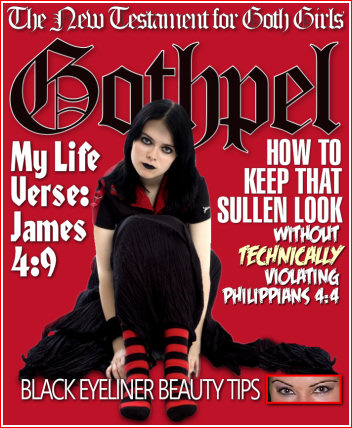
  • Ian Clary links to a Christian festival where he thinks "The New Testament for Goth Girls" might seriously be a hit. He says he's not linking to me in order to be BlogSpotted, but I'm going to mention him anyway.
  • Ray at "Observations and Opinions" does some serious thinking and has some edifying thoughts about the limits of our duty to be all things to all men.
  • Jason Clark can appreciate the humor in some of my comic-book parodies. But he thinks too many of you people who comment here seem to enjoy being "rude, denigrating, biting, [and] cutting." (You were talking about the people who are critical of me—right, Jason?)
  • William Dicks unleashes his blog readers on PyroManiac.
  • Jeff Jones thinks I'm "redoubtable." I think that means "capable of provoking repeated doubts"—as in, "I keep getting the feeling I'm not too sure about this guy."
  • Pedantic Protestant (who is that guy?) figures he's ok if I don't BlogSpot him. Busted.
  • Matt Gumm has a brilliant post today dealing with the disastrous dumbing down of Bible translations. He's done some careful work to document two different approaches to translating Romans 3:23 and 1 John 2:2 and 4:10, where the concept is plainly that of "propitiation"—a very specific and important idea—but some translators have deemed the expression "too technical to communicate to many modern readers."
  • Michael Spencer does a riff on the tattoo-and-piercing issue and adds a helpful addendum: "What Phil Johnson is describing—the confrontation of culture—is exactly right....IF by that we mean the culture is confronted with Christ and the Gospel, and not simply another culture." I'll add an amen to that—and a big hands-in-the-air charismatic-style salute to the example he gives.
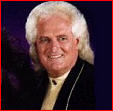
         In fact, here's the kind of "Christian culture" he rightly execrates: "Visit TBN and look at the hairstyles on everyone from Benny Hinn to
    Laverne Tripp
    Laverne Tripp
    Laverne Tripp to Jan Crouch. How is this different from the hair styles you would see on kids with piercings and tattoos? (It's, frankly, considerably weirder.)" Yeah, I've often wondered if Laverne Tripp really goes to Costco with his hair like that. He must get stared at and pointed at a lot, even by people who haven't a clue who he is. The rest of Michael's article is worthy of sober consideration, too.
         In fact, Michael's post prompted some thoughts I'll probably eventually blog about: historically, Christianity has elevated every culture it has penetrated. Beginning sometime in the past 150 years or so, however, the visible church (and I'm speaking very broadly here) has seemed to act as an incubator to some amazingly lowbrow and even circus-style subcultures. Shouldn't that clue us that something is seriously wrong, and shouldn't the mainstream be more wary of embracing the fringe, rather than more and more willing to accept aberrant theologies, aberrant cultures, aberrant styles, aberrant worship, and aberrant philosophies into our mainstream?
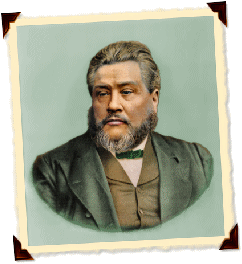
  • Confession time: I realize folks occasionally complain that my humor is too caustic or insufficiently considerate of the feelings of people who bear the brunt of my satire. My dear mom tells me that all the time, and she has borne the brunt of my satire more times than all my readers combined. For the record, I'm not insensitive to those concerns. I do not countenance name-calling, angry insults, or deliberate ill manners and bad behavior. And I do try to shut off the humor chip in my brain when I feel the sarcasm circuitry starting to overload. As Spurgeon once said, if you knew all the mischievous things I think about but never actually say, you would offer me hearty congratulations for my restraint.
         Nonetheless, I include this next BlogSpot as a cautionary tale for all of us. Here's something that puts the dangers of careless stridency in proper perspective:
         Darth Gill (aka Brandan Kraft) has some less-than-cogent and not-exactly-self-deprecating thoughts about arrogance, offensive language, pride, serious error, and theological discourse. He's "amazed at the number of people that routinely refer to [him] as mean, harsh, or arrogant." He'd really appreciate it if people would simply ignore his arrogance and listen to his opinions anyway. He does not and will not apologize "for calling others names and using derogatory terms such as stupid, idiot, ignorant fools." This memorable quip stood out especially: "Yes, I am mean harsh and arrogant. . . . If you dismiss or ignore me because of this, then it is nothing more than a pathetic exuse [sic] not to deal with the topics that I bring to you in this blog."
         Unfortunately, the "topics" Brandan brings to his blog, and his web page, and his discussion forum are all part of Brandan's relentless advocacy of the most radical hyper-Calvinist opinions. And since all who offer biblical arguments against his views automatically incur name-calling and denunciation from Brandan and many others in his crew, his blog is frankly a little hard to take except in small doses. In celebration of his defense of nasty arrogance, I've given Brandan's blog a place in my blogroll under "Appalling." Hopefully, its presence there will remind me to let my own speech (and writing) be seasoned with a little more grace.
  • Frank Martens tells a very poignant tale about his experience as the eldest son in a large family. Both Frank's and his sister's blogs speak well of their father's influence and the goodness of divine Providence.
  • Brian Colmery found Wednesday's post enjoyable.
  • Kevin Pierpont Notices the link to the "Grace to You" podcast over there in the Right-hand column.
  • Pierre Benz at "Bowl of Musing" enjoyed my correspondence with "Savage Countenance."
  • Jared at "The Thinklings" has been eavesdropping. De over there spotted the Biblezine parody. Here's another one:
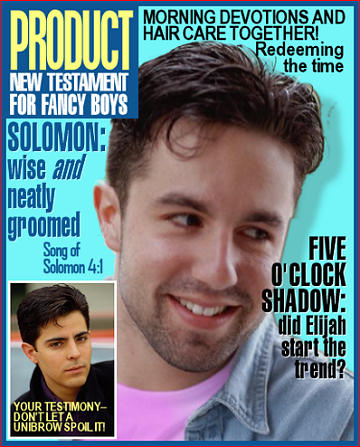
    Product: New Testament for Fancy-oys
    HT: Pecadillo

Phil's signature

29 September 2005

New Post

BlogSpotting (because I couldn't think of anything else to say)

BlogSpotting
Blogtool Update:

  1. The Truth Laid Bare suddenly rediscovered a bunch of links to PyroManiac that had gone missing. It's still not working correctly, though. I've seen several bloggers' references to the vacillating way it accounts for links. Almost everyone's numbers seem to go up and down wildly every day. And some pretty odd blogs keep popping in and out of the top rankings. I've concluded it's giving me stats and other data that are practically worthless. I understand it's only a part-time hobby for NZ Bear. No wonder he's had a hard time keeping up with the explosion of blogs. It's frankly amazing that the TTLB concept works at all without lots of staff and corporate resources to maintain it 24/7.
  2. IceRocket is still very reliable. It always returns results rather than error messages, and that's good. But it doesn't seem to search as many blogs or index as frequently as the other two search engines I use regularly.
  3. Technorati finally seems to be fixed. It's been more than a week since I got the "server busy" message. Let's hope they keep it running. It still seems slow to index new posts, but it's at least 400 percent better than 2 weeks ago. If it works for another week or so, I'll put the Technorati link back on my blog template.
  4. Google's Blog Search, as you'd expect, is already very good and getting better every day. It seems to update and index new posts more frequently than the others. I predict its performance is going to be very hard to beat. But hey, am I the only one who thinks all the tools related to Blogger.com (Google) have ugly interfaces? Between the three major search engines I've linked to here, the Blogger's Blog Search is far and away the ugliest. (My favorite is the slightly retro look of IceRocket.)

Phil's signature

28 September 2005

New Post

Still more from the e-mail out-box

The correspondence I posted yesterday prompted an e-mail from someone who was mildly irritated with me. Here's my reply:



To: "Savage Countenance"
From: "Phillip R. Johnson"
Subject: Re: Cr—t-r?!!

Dear "Savage Countenance,"

Many thanks for your message. You wrote:

> why would you question a brother
> who just wants to fit in with the
> people he's trying to reach?...you
> should quit trying so hard to be
> different and try harder to be
> genuine...i'm making this point
> b/c my eyebrow is pierced and i
> have a tatoo on the back of my
> neck...i wear combat boots...and
> i usually wear all black..i listen
> to Christian metal and industrial
> music—i've seen too many christians
> hide in a corner away from the world
> and wait for them to come to
> us...and it just doesn't work
> that way, you know?

OK, first of all let me say that the point I want to make here has very little to do with the question of whether body piercing and tattoos are always inherently sinful.

Don't misunderstand: I would indeed argue that if you pierce or tattoo yourself as an act of self-mutilation, narcissism, or rebellion, then the motivation for such "body modification" is clearly sinful and therefore something Christians ought to avoid.

But that's really beside the point at the moment. Because your whole argument is that you have tattooed yourself and put studs in your face in order to be more "genuine" and to have a better testimony for Christ.

And that's what I want to respond to: the notion that adopting the fads of a juvenile, egomaniacal, shallow, self-destructive, worldly culture "works" better as an evangelistic strategy than a lifestyle that gives more prominence to the principle of Matthew 5:16 and 1 Peter 2:9.

As you have described it above, body modification and combat boots are a significant and deliberate part—if not the very centerpiece—of your evangelistic strategy. You seem to imagine that if you try hard enough to fit into the punk culture, you might actually win people by convincing them that Jesus would fit nicely into their lifestyle, too.

But wouldn't you yourself actually agree that there is—somewhere—a limit to how far Christians can legitimately go in conforming to worldly culture? Surely you do not imagine that the apostle Paul's words about becoming all things to all men is a prescription for adopting every vulgar fashion of a philistine culture. Do you?

Can we agree, for example, that it wouldn't really be good or necessary to get a sex-change operation in order to reach the transgendered community? OK, you might dismiss that as something inherently sinful and wrong for that reason. Well, how about pulling a few teeth and adopting the trashy patois and tasteless lifestyle of Jerry Springer's guest list in order to have a more effective outreach to the underbelly of the cable-TV community? How serious are you about your strategy of accommodation and conformity?

And why is it mainly the lowbrow and fringe aspects of Western youth culture that this argument is invariably applied to? Why are so few Christian young persons keen to give up video games and take up chess in order to reach the geeks in the chess club? or give up heavy metal and learn the cello in order to have a ministry to the students who play in the orchestra?

There used to be a misguided youth on the Web who ran a website called "Backyard Wrestlers for Jesus." He was trying to tap into the backyard wresting culture as a mission field. So he set up a Web site showing kids how to build a backyard wrestling ring, how to do what The Rock and the Dudley Boys do without getting hurt, and how to talk smack without really talking dirty—so that kids who wrestle in their own backyards could improve their style. Along the way, he figured they would see that his Web site had something to do with Jesus, and they'd know Jesus is cool, and they'd like Jesus better because he's so cool.

I admire his desire to reach a troubled culture, but the methodology is all wrong and completely without any credible biblical warrant. I realize making Jesus seem cool is the dominant evangelistic strategy of this age, and everyone from Rick Warren to Brian McLaren is trying in whatever way they think best to make Christianity more hip and trendy.

But I still think it's a bad idea.

Incidentally, I grew up in the 1960s in a liberal church with a fairly sizable youth group where dances with live rock music were the bait used to draw us on a regular basis. So there's nothing particularly fresh or innovative about this philosophy. It didn't work in my generation, and it's not really working now. It's made the church more worldly; it hasn't made the world more spiritual.

In fact, I'd say that this strategy represents the wholesale abandonment of the church's responsibility to a sinful culture.

The most effective way to minister to any culture—and this goes for every culture, from highbrow society to white middle-class suburbia to the urban street gang—is to challenge and confront the culture instead of conforming to it. "Therefore 'Come out from among them and be separate, says the Lord. Do not touch what is unclean'" (2 Corinthians 6:17).

Yes, I know Jesus was a friend of sinners, and His enemies accused Him—wrongly—of participating in their excesses. The truth is that He became their friend without adopting their values. That's the example we should strive to follow, not the example of worldly culture itself.

Phil's signature


27 September 2005

New Post

More from the e-mail out-box


To: K___ B_____
From: "Phillip R. Johnson"
Subject: Cr--t-r?!

Dear K_____,

You wrote:

> I serve M-ss--h in a Jewish
> context. Hence the omission
> of the vowels in the names
> of G-d. You have my per-
> mission to publish any part
> of my messages you choose,
> but I have one request: Please
> do not edit my words so as to
> add the letters I have omitted.
>
> Were my post to come into the
> hands of a Jew, my credibility
> with the community would be
> suspect for writing out the
> name of the Cr--t-r. See what
> Rav' Shaul (the apostle Paul)
> wrote in 1 Cor. 9:20-21.

Perhaps you could explain this practice further. It seems to me that this is an accommodation to a superstition that is grounded in an unbiblical notion of what it means to take the Lord's name in vain. And as far as I can tell, it is not even the whole Jewish community who follow this superstition, but a fairly narrow segment of Hasidim.

Since the whole idea behind this practice goes against what Christ taught, I've always felt it is inappropriate for Christians to cater to it. We don't cross ourselves or bow to the communion elements in order to accommodate the superstitions of Roman Catholics. Why omit vowels in order to accommodate selected Pharisaic-style superstitions? (And even in the word Cr--t-r?!! That's the first time I've seen that.)

This isn't a case of obeying any law or tradition that reflects the true intent of the Old Testament commandments. In fact, it tacitly seems to sanction a perversion of God's law. It's precisely the kind of thing Y'shua refused to accommodate for the sake of pleasing overscrupulous Pharisees (cf. Mark 7:2-9). In fact, He attacked the myth that lies behind the superstition against pronouncing or spelling out the name of God (cf. Matthew 23:16-24).

I also think it's a huge and totally unwarranted logical leap to portray this practice as a legitimate application of the 1 Corinthians 9:20-21 principle: "Unto the Jews I became as a Jew, that I might gain the Jews; to them that are under the law, as under the law, that I might gain them that are under the law; To them that are without law, as without law . . . that I might gain them that are without law."

Since you've appealed to that text, I have four questions for you:

  1. Have you carefully considered the possibility that your observing this practice is perpetuating a myth about the appropriate way to express one's reverence for God's name? Again, I refer you to Mark 7:2-9 for our Lord's own example of how to deal with Jewish traditions that subvert the true meaning of the law.
  2. If the no-vowels-in-God's-name rule is a perversion of the law rather than a legitimate application of the third commandment, do you really imagine Rav' Shaul would have sanctioned it?
  3. Do you follow both sides of Rav' Shaul's maxim? When you write to me, you're writing to a Goy. So why do you insist on retaining (and to a large degree, it seems, flaunting) the ceremonial and religious accoutrements of Jewish culture? What about becoming as one who is without law to them who are without law? Do you ever do that? Or are you treating certain Old Testament ceremonial requirements as inviolable, even among the Goyim?
  4. Are you really Jewish? Because in my experience, a high percentage of Christians who imitate Hasidic practices are not really from orthodox Jewish backgrounds at all, but Goyim-born Hebrew-wannabes (or secular Jews who have embraced Christ as Meshiach)—with the mistaken notion that cloaking the Christian faith in the robes and phylacteries of Orthodox Jewish religious traditions somehow makes Christianity seem more "authentic." (As if Christ were not Savior of the Goyim, too.) That's the very mindset that gave rise to Galatianism, and it's a troubling and persistent tendency of Messianic Judaism, I fear.

You wrote,

> As a trained Rav', surely Shaul
> would have not have shown such
> disrespect to G-d's name as to
> write it out when corresponding
> with fellow Jews.

However, he did just that, in his epistle to the Romans, which included Jewish recipients.

And he certainly would not have shown such disrespect to his Gentile brethren as to insist on treating God's name as unspeakable in his correspondence with them. Nothing you have said explains why you insist on observing Hasidic superstitions in your correspondence with me.

Thus my objection to the missing vowels still stands. This is not a legitimate principle of Old Testament law, but a manufactured tradition invented by men, or worse—a matter of superstition based on a serious corruption of the law.

And I think it is a serious mistake for Christians to play along with such superstitions.

Phil's signature


25 September 2005

New Post

Monday Menagerie XVII

PyroManiac devotes Monday space to esoteric and offbeat things, in the hope that these will supply learning experiences for us all.

The pioneer of polemic taxidermy, or building imaginary monsters as a satirical apologetic device

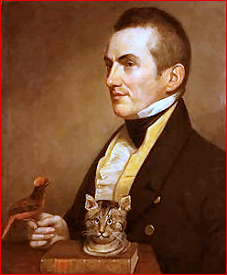
Charles WatertonCharles Waterton is one of the great eccentrics of English history (and let's be honest: that's a long story really full of peculiar characters).
Waterton was born at Walton Hall, in West Yorkshire, on June 3, 1782. He died at that same estate on May 27, 1865. In between, he traveled the world and made quite a name for himself.

His religion

If Waterton were looking over my shoulder right now, he himself would demand that any biographical sketch about him begin with the fact that he was Roman Catholic. He was an ardent and very proud Catholic. His ancestry, he claimed, included seven full-on Roman Catholic saints, ranging from Vladimir the Great to Sir Thomas More. British Roman Catholic author Graham Greene said, "Roman Catholicism has always been a great breeder of eccentrics in England. One cannot picture a man like Charles Waterton belonging to any other faith."

During his youth, Waterton's family was burdened by financial difficulties, which he blamed on the political policies of the Hanoverian Protestants. He grew up with a deep contempt for Protestants and Protestantism, and he practically wore his disrespect on his sleeve. He would attend meetings of the Protestant Reformation Society and heckle speakers whenever they used words like "Popery," or "Romanism."

His wit and his work

Charles Waterton was nonetheless a likeable man with a lively sense of humor and a roguish wit.

In fact, while Waterton was always a "good Catholic," he was not always a well-behaved one. In 1817, at age 35 (an age when lesser men have already begun to lose their youthful mischievousness) Waterton visited the Vatican. Touring the dome of St. Peter's, he climbed to an almost inaccessible lightning-rod on the roof and placed one of his gloves on top of it, like a flag. This caught the attention of no less than Pope Pius VII, who was not amused and demanded that the glove be removed. Waterton obliged, making the difficult climb for the second time in two days.

Climbing was one of Charles's passions. He was a prodigious climber, who could scale almost any wall, tree, or rock face. It is said that even at age 80, he still thought nothing of shinnying up a tree to examine a bird's nest.

This ability went well with his career. Waterton was a naturalist.

His career

In 1804, at age 22, Charles Waterton went to Guyana, where he oversaw the large estate of an uncle. This was a perfect life for an early nineteenth-century naturalist who wanted to make a mark in that field of study. He was the first to bring a usable sample of the poison curare back to England for study. He was a contemporary, acquaintance, and sometimes mentor to Charles Darwin (though he reportedly had little respect for Darwin's work). Many species of birds and other creatures in the West Indies were discovered and first described by Charles Waterton.

Near the end of his life, Waterton built a nine-foot wall around the family estate, effectively creating the world's first wildlife preserve. He also fought one of the first successful conservation campaigns—a long legal battle he waged and finally won against a soap manufacturer who was allowing chemicals to run downstream onto Waterton's property. Many of his ideas, which seemed as bizarre as his ultra-short haircut in his own time, are now (like the haircut) accepted as mainstream.

But there's still no denying that the man's eccentricity ran deep. It wasn't merely that he wore a buzz cut in an era when long hair was considered an essential part of good grooming; he also was known for bizarre antics like biting guests on the leg under the table like a dog. He also was flexible enough to scratch behind his ear with his big toe, and he loved to demonstrate that ability. And he deliberately bled himself copiously and regularly, believing this was how the body healed itself. He referred to the practice as "tapping one's claret."

His marriage

Understandably, Waterton remained unmarried until age 48, when he was wed to a girl 31 years his junior. She was an orphan with whom he had become infatuated in her infancy. He waited till she was old enough to marry, and by all accounts, their brief marriage was a happy one, but she died a year later from complications related to the birth of their son.

Charles was burdened with guilt related to his wife's death, and from that time on, he used a wooden block as a pillow, apparently as a form of penance.

His taxidermy

He practiced taxidermy as an extension of his work as a naturalist, and the skill he developed was remarkable. He pioneered the use of mercuric chloride to make the animal-skin hard and ward off harmful insects. Unlike other taxidermists, who stuffed specimens to fill them out after dissection, Waterton developed a process of shaping and hardening the animal skin, so that many of his finished works were hollow. This was a time-consuming process, but it enabled Waterton to mix taxidermy and high art. He found he could manipulate hides in order to give the animals a lifelike stance and appearance.

In 1824 Waterton returned more or less permanently to England to be the squire of his ancestral home, Walton Hall, (after 20 years in Guyana, and just a few years before his short-lived marriage).

Back home, he found an even more interesting use for his ability to sculpt animal hides.

"The Nondescript"

On one of his trips through British customs at Liverpool, an inflexible and rather stern customs inspector, one Mr. Lushington, informed Waterton that he would have to pay the highest commercial duty for the importation of animal specimens from the New World.

Waterton protested, complaining that the specimens were museum pieces and of no commercial value. Lushington was unyielding, and though Waterton argued long and passionately, in the end, he had no choice but to pay an exorbitant price to get his collection home.

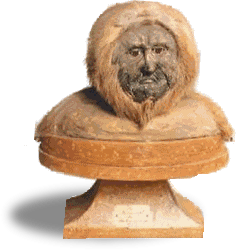
The NondescriptAfter his next trip to the West Indies, Waterton returned with an animal specimen he labeled "The Nondescript." He claimed it was the preserved remains of a large animal, nearly human. It had furry skin but a human face. Many naturalists of the day were fooled by it. People who saw it were aghast, wondering if the creature Waterton had killed and mounted might have been truly human. It was in fact the skin of a red howler monkey, with an artificial face formed from the animal's backside, and carefully sculpted to look like Agent Lushington.

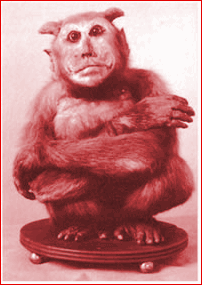

from the frontispiece of Waterton's book
"The Nondescript," from the frontispiece of Waterton's book
The practical joke was not discovered for some time, and the details of its craftsmanship are still disputed by experts. But "The Nondescript" became the inspiration for other similar frauds, most notably the Piltdown Man.


Other creations

Martin Luther After His Fall
"Martin Luther After His Fall"
Waterton began using his taxidermist's skills to make monstrous caricatures as satires to lampoon his Protestant enemies. One creation was "Martin Luther After His Fall," a monkey that had been given human facial features and horns.

"Noctifer" was made of an owl combined with a long-legged marsh bird, symbolizing (in Waterton's own words) "the Spirit of the Dark Ages, unknown in England before the Reformation." (No one ever claimed he was an expert in history.)

John Bull and the National Debt
"John Bull and the National Debt"
Other creations by Waterton made political statements, such as "John Bull and the National Debt," A porcupine with a turtle-shell, being attacked by devils. Even this had an anti-Protestant message, because Waterton blamed virtually every financial ill in England on the Hanoverian Protestants until the day of his death.

What can we learn from this?

I (of all people) can certainly appreciate Waterton's sense of humor, even though I disagree completely with most of the sentiments expressed by his satire. In those days, long before humor began to carry the same social stigma as deliberate cruelty, Waterton's humor was usually appreciated on some level by friends and foes alike. His sense of humor made even an outlandish eccentric like Waterton seem approachable and likable.

As someone who often defends the legitimate use of satire and sarcasm, I want to acknowledge that (while a caricature can often make a valuable point in bold relief) there's a lesson to be learned in the opposite direction, too: If the only thing you have is a stuffed animal made of borrowed parts of this and that, you don't really have much of an argument.

Grotesque taxidermy specimens and comic-book covers are good for illustrative purposes, and the right use of humor can lighten even the most serious discussions. (Here's hoping humor itself will never be totally outlawed by "polite" society.) But caricatures and manufactured monsters are valid only if they substantiate an argument that has elsewhere been made rationally, with true facts, solid logic, and reasonable arguments.

I think we can all agree on that.

Still, if the rational argument has been made, the stuffed monkey can be a very useful illustration or icebreaker. I sometimes wish I had the skill, time, and resources to do taxidermy.

For further study:

  1. "Charles Waterton," from the Catholic Encyclopedia
  2. "The Gentle Art of Political Taxidermy: Charles Waterton, Squire of Walton Hall,"
    by Sally Shelton, from Annals of Improbable Research
  3. The Charles Waterton Home Page
  4. Wanderings in South America, a free eBook by Charles Waterton

Phil's signature

New Post

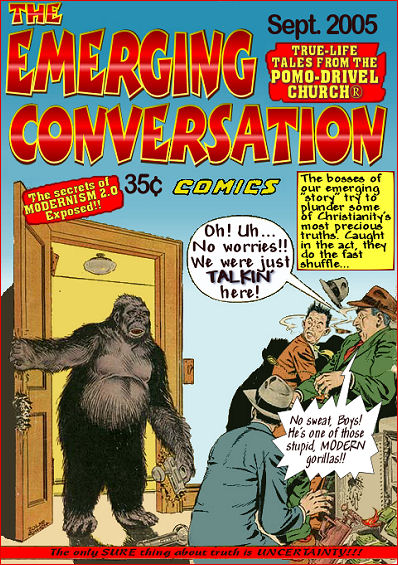
Oh, it's a conversation? Huh? My two cents? Sure...

Here's 35 cents worth:

Phil's signature

24 September 2005

New Post

Some recycled thoughts for the weekend: Brian McLaren and the assurance of faith

PyroManiacBack in April, about the time I began seriously thinking about entering the blogosphere, Tim Challies featured an enthusiastic review of Bob DeWaay's insightful critique of Brian McLaren's A Generous Orthodoxy. I like Bob DeWaay's plain-spoken, sensible approach to analyzing hard issues, and Challies' blogpost about that particular article was also very succinct and to the point.
I especially liked one sentence where Challies contrasted historic Reformation Christianity with McLaren's post-whatever Emergent-style religion.

So I left a short comment expressing my appreciation for the clarity of this one statement by Challies: "This may be the very heart of a postmodern versus Reformational understanding of Scripture. The Reformers believed that man could know and could understand the Bible. The postmodernist cannot see beyond the fallibility of the one who does the reading."

Some of the commenters at Challies' blog were more or less sympathetic with the "Emerging Church Conversation," and a lively exchange was already taking place there, even before I posted—especially on the subjects of faith, knowledge, spiritual understanding, and the confidence with which a Christian is entitled to express the grace of assurance.

Here's an edited summary of some things I wrote in the brief dialogue that ensued. I'm recycling these thoughts here, because they expand on some remarks I have posted over the past two days:

Certainty

No one in his right mind would suggest that "we have no limitations when it comes to [understanding] the Bible." But it seems rather obvious that if divine grace really does enable us to know truth (as we are taught in several passages like 1 John 2:20; Hebrews 8:11; 1 Corinthians 2:10-16), then certainty, confidence, righteous conviction, and the assurance of faith are by no means impossible for redeemed sinners.

It's true that our knowledge is imperfect until we are glorified (1 Corinthians 13:12). Still, what our faith enables us to know (albeit imperfectly) is objectively true. Our fallibility doesn't nullify Scripture's infallibility. We don't need to doubt that which is sufficiently clear in Scripture.

And despite what McLaren and other postmodernists insist, it is not necessary to argue that someone's reading of the Bible is infallible in order to discover significance in the truth that the Bible itself is objectively infallible.

Unlike postmodernism (which has no room for certainty of any kind), the Reformers (with Scripture on their side), stressed the perspicuity, authority, and absolute certainty of the essential gospel message. Reformation theology highlighted the biblical promise of the assurance of faith. That was one of the ways Reformation theology differed most dramatically from Medieval Roman Catholicism, and it is the very thing postmodernist theology seems bent on destroying.

The Reformers' consensus on these matters is carefully spelled out in the Westminster Confession of Faith. After affirming the authority and sufficiency of Scripture, the Confession says:

All things in Scripture are not alike plain in themselves, nor alike clear unto all; yet those things which are necessary to be known, believed, and observed, for salvation, are so clearly propounded and opened in some place of Scripture or other, that not only the learned, but the unlearned, in a due use of ordinary means, may attain unto a sufficient understanding of them.

The Confession goes on to speak of "an infallible assurance of faith, founded upon the divine truth of the promises of salvation, the inward evidence of those graces unto which these promises are made, [and] the testimony of the Spirit."

Isn't that the very thing McLaren denies? I've heard him mention "certainty" dozens of times, always to denigrate the assurance of Christians who (in his opinion) are too cocksure about what they believe.

Arrogance

I don't deny that there are many people out there who have a poor testimony for Christ because they are too smug about things they have blindly and brashly embraced. (That includes hordes of "emergent" Christians, too, by the way.) But I think it's a serious mistake to suggest that every expression of assurance or certainty is carnal or unjustified. Assurance—which stems from faith in what God has revealed—is presented in Scripture as a virtue. It is not the same thing as arrogance, which is overconfidence in the flesh.

By comparison with the faith of the Reformers, the emergent variety of "faith" seems a very cynical brand of dogma, obsessed with uncertainty rather than assurance; glorying in self-doubt rather than confidence.

In my estimation, this perpetual uncertainty about anything and everything, though claiming to be a form of humility, is in fact shot through with the very worst kind of human arrogance. Often, I fear, it is a subtle expression of unbelief.

Perspicuity

Curiously StrongAt this point in the conversation, someone wrote, "I'd suggest that the things that are 'sufficiently clear in Scripture' [are] relatively few things . . .and most of them are the main important things that even McLaren and John Shelby Spong (who is not a postmodern, btw!) agree with."
My reply:


Knowing how much biblical truth Spong rejects, it's pretty hard to see that statement as anything other than a practical denial of the perspicuity of Scripture.

The Bible's clarity can't be measured by an opinion poll to see how many people agree on what it means. If you really think Scripture is that unclear, it seems to me that you have eliminated the ground of Christian certainty after all. You've managed to demonstrate rather than refute my point about the utter inability of postmodernism to accommodate any meaningful degree of biblical certainty or conviction.

When you go on to suggest that McLaren's criticisms of certainty "were always in the context of things beyond the basics of Christianity"—that's a pretty hollow reassurance if your view of "the basics of Christianity" includes nothing more than Bishop Spong would affirm.

No significant critic of the emergent movement has ever suggested that "if you cannot know something omnisciently then you can't know anything." The point we're making is practically the polar opposite: You don't need to know anything "omnisciently" to be certain about some things. Specifically, we can be certain that what God has revealed is true.

Now, the true disciple of Brian McLaren will instantly claim I haven't solved anything with that affirmation, because the process of knowing "what God has revealed" is too subjective and we as sinners are too prone to misunderstanding. If we can't even be sure what God has revealed, it's an empty claim to say that "we can be certain that what God has revealed is true." So in the end, the only biblical certainties are reduced to a few meaningless (and, frankly, still-debatable) propositions that even Bishop Spong might assent to.

Sorry. My faith brings enough assurance to permit me to say I am absolutely certain Bishop Spong is grossly wrong even if Bishop Spong doesn't seem to understand that he is grossly wrong. I'm not convinced Brian McLaren could honestly say that. It's certainly not characteristic of the kinds of things he has said. In fact, he has rather pointedly made it clear that this is just the kind of certainty he hates. He thinks it is high-handed and egotistical.

Well, I think it's high-handed and egotistical to insist that God hasn't spoken with sufficient clarity. My judgment would be that the pomo-attitude of "Hey, i don't know everything . . .this is what i believe . . .i could be wrong, but let's not quibble over it and go get a beer—" is arrogant in the extreme.

McLaren is unsure of things no Christian ought to be unsure of. He doubts the authority of Scripture. He questions the exclusivity of Christ. He can't seem to find a clear moral compass in Scripture. All of this stems from his postmodern relativism.

Relativism

Now, obviously, as a clever relativist, McLaren would never admit to being an absolute relativist (pardon the expression). So he claims he is certain about a select few things, such as the fact that he is a "sinner"—which in his case (since he doesn't seem to have a very orthodox hamartiology) turns out to be just another way of saying he is fallible and therefore shouldn't be too dogmatic about anything. Nonetheless, some of his readers have apparently swallowed the argument that this claim absolves him from any and every charge of relativism.

It doesn't. At the end of the day, when Brian McLaren is done dissecting the Christian faith, there clearly is not a whole lot left that Christians can be certain about. You can argue that it's hyperbole to say that McLaren "believes nothing can really be believed." Fine. But it is certainly true that there's not much of any real substance that he thinks Christians ought to be certain about. And that approach to Christianity lacks biblical and historical integrity. It is rooted in relativism, and it does undermine the very soul of Christian assurance.

Skepticism

The rise of Open Theism, which was cited by someone as "proof" that we shouldn't be too certain of our theology in this postmodern day and age, actually illustrates my point. If we suddenly can't even be confident about something as essential as divine foreknowledge, then how can we really say we "know" the God of Scripture? And if we don't know the one true God (or can't really say with a high degree of certainty that we know Him), we really don't know anything worth knowing, do we?

So McLaren's "new kind of Christian[ity]" turns out to be little more than optimistic skepticism. Sound irrational? I think it is.

I've read McLaren's responses to his critics, including his open letter to Chuck Colson. I don't agree that McLaren has successfully answered the major criticisms that have been leveled at him. I think he has just dug himself deeper into a dry well. But that's a subject for another day.

See also:


Phil's signature

23 September 2005

New Post

Oh, why not? Here:

BlogSpotting


Miscellany

fireballSpeaking of hurricane damage, I realize I promised to post links to recommended relief agencies. I'm not finished compiling the list; I hope to get it posted shortly after the current hurricane crisis is over.
fireballAfter almost four months in the blogosphere, I still have no clue what BlogShares is all about, but my blog is getting more expensive than I can afford. I'll tell you what: anyone who wants to buy it, I'll take half that amount for it.

Phil's signature

22 September 2005

New Post

An excellent jeremiad from Mr. Spurgeon

The following excerpts are from an editorial Charles Spurgeon published in The Sword and the Trowel in 1871, more than a decade before the famous Downgrade Controversy.

Spurgeon makes no effort to disguise his passion for the truth, hide his contempt for the skepticism of the day, or otherwise tone down his rhetoric in order to mollify people who were demanding that he be more "charitable" in his treatment of unorthodox opinions.

He also had nothing but disdain for the notion that uncertainty is a mark of holy humility or a sign of intellectual sophistication that ought to be cultivated.

The arguments Spurgeon employs make it clear that the movement he opposed (nineteenth-century modernism) had a lot in common with the postmodern cynicism that infects the wider evangelical movement today. He leaves little doubt about how he would respond to the writings of Brian McLaren, Steve Chalke, Tony Campolo, the Open Theists, and their fellow post-evangelicals.

Here are some especially poignant excerpts:

That these gentlemen . . . are not liberal, but intolerant to the last degree, is evident, from their superciliousness towards those poor simpletons who abide by the old faith.

Why, it's almost as if he had been reading the latest issue of Christianity Today or surfing through some of the blogs I monitor:

Let half a word of protest be uttered by a man who believes firmly in something, and holds by a defined doctrine, and the thunders of liberality bellow forth against the bigot. Steeped up to their very throats in that bigotry for liberality, which, of all others, is the most ferocious form of intolerance, they sneer with the contempt of affected learning at the idiots who contend for "a narrow Puritanism," and express a patronizing hope that the benighted adherents of "a half-enlightened creed" may learn more of "that charity which thinketh no evil."

Sounds suspiciously like some fellows I know who regularly use "TR" or "RB" (acronyms for "truly Reformed" and "Reformed Baptist") against their adversaries as if those were the grossest of obscenities.

To contend earnestly for the faith once delivered to the saints is to them an offense against the enlightenment of the nineteenth century; but, to vamp old, worn-out heresies, and pass them off for deep thinking, is to secure a high position among minds "emancipated from the fetters of traditional beliefs."

Spurgeon was quoting the precise expressions broad churchmen had published. He was clearly the unnamed target of their disdain. The hypocrisy of their subsequent pleas for "charity" was obvious.

Great is their indignation at the creeds which render their position morally dubious. Churches have no right to believe anything; comprehensiveness is the only virtue of a denomination; precise definitions are a sin, and fundamental doctrines are a myth: this is the notion of "our foremost men." For earnest people to band themselves together to propagate what they hold to be the very truth of God, is in their eyes the miserable endeavor of bigots to stem the torrent of modern thought. . . .

The proper course, according to their "broad views," would be to leave doctrines for the dunces who care for them. Truths there are none, but only opinions; and, therefore, cultivated ministers should be left free to trample on the most cherished beliefs, to insult convictions, no matter how long experience may have matured them, and to teach anything, everything, or nothing, as their own culture, or the current of enlightened thought may direct them. . . .

Notice that the modernists of Spurgeon's era apparently had the same distaste for strong convictions that infects their twenty-first-century postmodern cousins:

It appears to be, now-a-days, a doubtful question whether Christian men have a right to be quite sure of anything. . . . He who teaches an extravagant error is a fine, generous spirit: and, therefore, to condemn his teaching is perilous, and will certainly produce an outcry against your bigotry. Where the atonement is virtually denied, it is said that a preacher is a very clever man, and exceedingly good; and, therefore, even to whisper that he is unsound is libelous: we are assured that it would be far better to honor him for his courage in scorning to be hampered by conventional expressions. Besides, it is only his way of putting it, and the radical idea is discoverable by cultured minds. As to other doctrines, they are regarded as too trivial to be worthy of controversy. . . .

The right to doubt is claimed clamorously, but the right to believe is not conceded. The modern gospel runs thus: "He that believes nothing and doubts everything shall be saved." Room must be provided for every form of skepticism; but, for old-fashioned faith, a manger in a stable is too commodious. Magnified greatly is the so-called "honest doubter," but the man who holds tenaciously by ancient forms of faith is among "men of culture" voted by acclamation a fool.

Hence, it becomes a sacred duty of the advanced thinker to sneer at the man of the creed, a duty which is in most cases fully discharged; and, moreover, it is equally imperative upon him to enter the synagogue of bigots, as though he were of their way of thinking, and in their very midst inveigh against their superstition, their ignorant contentedness with worm-eaten dogmas, and generally to disturb and overturn their order of things. What if they have confessions of faith? They have no right to accept them, and, therefore, let them be held up to ridicule.

Men, now-a-days, occupy pulpits with the tacit understanding that they will uphold certain doctrines, and from those very pulpits they assail the faith they are pledged to defend. The plan is not to secede, but to operate from within, to worry, to insinuate, to infect. Within the walls of Troy, one Greek is worth half Agamemnon's host; let, then, the wooden horse of liberality be introduced by force or art, as best may serve the occasion. Talking evermore right boastfully of their candor and hatred of the hollowness of creeds, etc., they will remain members of churches long after they have renounced the basis of union upon which these churches are constituted. Yes, and worse; the moment they are reminded of their inconsistency they whine about being persecuted, and imagine themselves to be martyrs.

Spurgeon was well aware of how his criticism would be viewed by the tolerance-police of his day:

This is most illiberal talk in the judgment of our liberal friends, and they will rail at it in their usual liberal manner; it is, however, plain common sense, as all can see but those who are willfully blind.

His reply was a reminder about the source and the nature of the truth he was defending:

While we are upon the point, it may be well to inquire into the character of the liberality which is, now-a-days, so much vaunted. What is it that these men would have us handle so liberally? Is it something which is our own, and left at our disposal? If so, let generosity be the rule. But no, it is God's truth which we are thus to deal with, the gospel which he has put us in trust with, and for which we shall have to render account. . .

If truth were ours, absolutely; if we created it, and had no responsibilities in reference to it, we might consider broad-church proposals; but, the gospel is the Lord's own, and we are only stewards of the manifold grace of God, and of stewards it is not so much required that they be liberal, but that they be found faithful.

He took a low view of that fashionable brand of "charity" which demanded approval for various new-fangled expressions of infidelity:

Moreover, this form of charity is both useless and dangerous. Useless, evidently, because all the agreements and unions and compromises beneath the moon can never make an error a truth, nor shift the boundary-line of God's gospel a single inch. If we basely merge one part of Scriptural teaching for the sake of charity, it is not, therefore, really merged, it will bide its time, and demand its due with terrible reprisals for our injustice towards it; for half the sorrows of the church arise from smothered truths.

False doctrine is not rendered innocuous by its being winked at. God hates it whatever glosses we may put upon it; no lie is of the truth, and no charity can make it so. Either a dogma is right or wrong, it cannot be indifferent. . . .

The rule of Christians is not the flickering glimmer of opinion, but the fixed law of the statute book; it is rebellion, black as the sin of witchcraft, for a man to know the law, and talk of conceding the point. In the name of the Eternal King, who is this liberal conceder, or, rather, this profane defrauder of the Lord, that he should even imagine such a thing in his heart?

Nor is it less important to remember that trifling with truth is to the last degree dangerous. No error can be imbibed without injury, nor propagated without sin. The utmost charity cannot convert another gospel into the gospel of Jesus Christ, nor deprive it of its deluding and destroying influence. There is no ground for imagining that an untruth, honestly believed, is in the least changed in its character by the sincerity of the receiver; nor may we dream that the highest culture renders a departure from revealed truth less evil in the sight of God.

If you give the sick man a deadly poison instead of a healing medicine, neither your broad views of chemistry, nor his enlightened judgment upon anatomy, will prevent the drug from acting after its own nature.

Spurgeon reminded his detractors of how the apostles responded to false teaching, and of the dangers of flirting with unbelief:

Paul pronounced a curse upon any man or angel who should preach another gospel, and he would not have done so, if other gospels were harmless. It is not so long ago that men need forget it, that the blight of Unitarian and other lax opinions withered the very soul of the Dissenting Churches; and that spirit has only to be again rampant, to repeat its mischief. Instances, grievous to our inmost heart, rise up before our memory at the moment of men seduced from their first love, and drawn aside from their fathers' gospel, who only meant to gather one tempting flower upon the brink of the precipice of error, but fell, never to be restored.

No fiction do we write, as we bear record of those we have known, who first forsook the good old paths of doctrine, then the ways of evangelic usefulness, and then the enclosures of morality. In all cases, the poison has not so openly developed itself, but we fear the inner ruin has been quite as complete. In the case of public teachers, cases are not hard to find where little by little men have advanced beyond their "honest doubt," into utter blasphemy.

Spurgeon's closing words are a fitting reply to the purveyors of doubt in our era:

We are not believers in stereotyped phraseology, nor do we desire to see the reign of a stagnant uniformity; but, at this present, the perils of the church lie in another direction. The stringency of little Bethel, whatever may have been its faults, has no power to work the mischief which is now engendered by the confusion of the latitudinarian Babel. To us, at any rate, the signs of the times portend no danger greater than that which can arise from landmarks removed, ramparts thrown down, foundations shaken, and doctrinal chaos paramount.

We have written this much, because silence is reckoned as consent, and pride unrebuked lifts up its horn on high, and becomes more insolent still. Let our opponents cease, if they can, to sneer at Puritans whose learning and piety were incomparably superior to their own; and, let them remember that the names, which have adorned the school of orthodoxy, are illustrious enough to render scorn of their opinions, rather a mark of imbecility than of intellect.

To differ is one thing, but to despise is another. If they will not be right, at least, let them be civil, if they prefer to be neither, let them not imagine that the whole world is gone after them. Their forces are not so potent as they dream, the old faith is rooted deep in the minds of tens of thousands, and it will renew its youth, when the present phase of error shall be only a memory, and barely that.

Twenty-first century postmodern "emerging" types in the church love to try to paint themselves as the polar opposite of modernists. The fact that Spurgeon's criticism of early modernism so perfectly refutes the rhetoric of the postmodern innovators shows why that claim is bogus. Far from being the antithesis of modernism, "evangelical postmodernism" is really nothing more than Modernism 2.0.

Phil's signature

21 September 2005

New Post

How far did Spurgeon's liberality go?

Spurgeon"There is no bigotry in the world equal to the bigotry of modern liberalism. Sectarianism may be bitter, but latitudinarianism is wormwood and gall."—C. H. Spurgeon, from "Ourselves and the Annexationists", in The Sword and the Trowel



A time to embrace

In the comments section of yesterday's post, someone posted a portion of one of my favorite quotes from Spurgeon. The full paragraph it was extracted from is a tad long, but the additional context is well worth reading:

It has been the desire of the true Calvinist,—not of the hyper-Calvinists, I cannot defend them—to feel that if he has received has received more light than another man, it is due to God's grace, and not to his merits. Therefore charity is inculcated, while boasting is excluded. We give our hand to every man that loves the Lord Jesus Christ, be he what he may or who he may. The doctrine of election, like the great act of election itself, is intended to divide not between Israel and Israel, but between Israel and the Egyptians,—not between saint and saint, but between saints and the children of this world. A man may be evidently of God's chosen family, and yet though elected, may not believe in the doctrine of election. I hold that there are many savingly called, who do not believe in effectual calling, and that there are a great many who persevere to the end, who do not believe the doctrine of final perseverance. We do hope that the hearts of many are a great deal better than their heads. We set not their fallacies down to any wilful opposition to the truth as it is in Jesus, but simply to an error in their judgments, which we pray God to correct. We hope that if they think as mistaken too, they will reciprocate the same Christian courtesy; and when we meet around the cross, we hope that we shall ever feel that we are one in Christ Jesus, even though as yet the ministering spirit has not led all of us into all the lengths and breadths of the truth—C. H. Spurgeon, "Effects of Sound Doctrine," a sermon delivered on Sunday evening April 22nd, 1860.

Alongside that excerpt, this quote from "A Defense of Calvinism" was also posted in a comment yesterday. It's a commonly-cited section, but this one is also worth hearing again. Here it is, with a little additional context:

There is no soul living who holds more firmly to the doctrines of grace than I do, and if any man asks me whether I am ashamed to be called a Calvinist, I answer—I wish to be called nothing but a Christian; but if you ask me, do I hold the doctrinal views which were held by John Calvin, I reply, I do in the main hold them, and rejoice to avow it. But far be it from me even to imagine that Zion contains none but Calvinistic Christians within her walls, or that there are none saved who do not hold our views. Most atrocious things have been spoken about the character and spiritual condition of John Wesley, the modern prince of Arminians. I can only say concerning him that, while I detest many of the doctrines which he preached, yet for the man himself I have a reverence second to no Wesleyan; and if there were wanted two apostles to be added to the number of the twelve, I do not believe that there could be found two men more fit to be so added than George Whitefield and John Wesley. The character of John Wesley stands beyond all imputation for self-sacrifice, zeal, holiness, and communion with God; he lived far above the ordinary level of common Christians, and was one "of whom the world was not worthy." I believe there are multitudes of men who cannot see these truths, or, at least, cannot see them in the way in which we put them, who nevertheless have received Christ as their Saviour, and are as dear to the heart of the God of grace as the soundest Calvinist in or out of Heaven.

By the way, that second quotation is taken from the same article in which Spurgeon made another famous statement—one of his most controversial statements about Calvinism ever:
I have my own private opinion that there is no such thing as preaching Christ and Him crucified, unless we preach what nowadays is called Calvinism. It is a nickname to call it Calvinism; Calvinism is the gospel, and nothing else.

Some very narrow Calvinists love to cite that third quote apart from its context as if it proved Spurgeon rejected all Arminians as infidels. Clearly, that is not what he meant.

In fact, the context of the full article makes clear precisely what Spurgeon did mean in that third quotation: He was simply saying that the central principle of Calvinism is the very gist of the gospel: Salvation is God's work; it is not something the sinner can do for himself. Plainly, he was not insisting that the only authentic Christians are Calvinists. The first and second quotations above make his position on that issue quite clear.

I agree with all three of those statements, of course. I also agree with the use Spurgeon made of the principle he was defending. Although he had no sympathy whatsoever for Arminian theology, he was charitable toward Christians who struggled to understand the doctrines of grace. Even though he regarded Arminianism as a serious error and a system fraught with all kinds of theological mischief, he did not automatically write off all Arminians as non-Christians.

Spurgeon held this position precisely because he did not believe Arminian opinions about free-will, unconditional election, or the extent of the atonement were tantamount to a denial of any fundamental, inviolable point of gospel truth. Which is to say that while Spurgeon clearly regarded the central idea of Calvinism as a truth that embodied the very essence of the gospel, he obviously did not regard every aspect of the doctrines of grace as essential gospel truth.

In other words, Spurgeon taught that the principle of grace per se is a primary and essential truth. But when it came to some of the more technical aspects of Calvinistic doctrine, including the doctrines of perseverance and effectual calling, he regarded them as secondary, and he allowed that a genuine believer in Christ might—through confusion or ignorance—reject those truths. He embraced people who made such a profession of faith as authentic brothers and sisters in Christ.

A time to refrain from embracing

On other issues, however, Spurgeon was unwilling to grant such latitude. He made it perfectly clear that he regarded the principles of substitutionary atonement and justification by faith as absolute essentials—and he steadfastly refused to embrace or give encouragement to the purveyors of alternative opinions on those points:

The largest charity towards those who are loyal to the Lord Jesus, and yet do not see with us on secondary matters, is the duty of all true Christians. But how are we to act towards those who deny his vicarious sacrifice, and ridicule the great truth of justification by his righteousness? These are not mistaken friends, but enemies of the cross of Christ. There is no use in employing circumlocutions and polite terms of expression:—where Christ is not received as to the cleansing power of his blood and the justifying merit of his righteousness, he is not received at all.—Spurgeon, "A Fragment Upon the Down-Grade Controversy."

Spurgeon steadfastly refused to admit anyone who denied any essential doctrines of Christianity into the circle of his fellowship, and he regarded all attempts to seek Christian fellowship with such false teachers as sinful:

It used to be generally accepted in the Christian Church that the line of Christian communion was drawn hard and fast, at the Deity of our Lord; but even this would appear to be altered now. In various ways the chasm has been bridged, and during the past few years several ministers have crossed into Unitarianism, and have declared that they perceived little or no difference in the two sides of the gulf. In all probability there was no difference to perceive in the regions where they abode. It is our solemn conviction that where there can be no real spiritual communion there should be no pretense of fellowship. Fellowship with known and vital error is participation in sin. Those who know and love the truth of God cannot have fellowship with that which is diametrically opposed thereto, and there can be no reason why they should pretend that they have such fellowship.—Ibid.

The whole of the article is well worth reading.

So Spurgeon was no latitudinarian, and he had no patience whatsoever for the convoluted "liberality" the modernists of his day were peddling (and postmodernists today are likewise attempting to foist on well-meaning Christians):

I should like to ask modern broad churchmen whether there is any doctrine of any sort for which it would be worth a man's while to burn or to lie in prison. I do not believe they could give me an answer, for if their latitudinarianism be correct, the martyrs were fools of the first magnitude. From what I see of their writings and their teachings, it appears to me that the modern thinkers treat the whole compass of revealed truth with entire indifference; and, though perhaps they may feel sorry that wilder spirits should go too far in free thinking, and though they had rather they would be more moderate, yet, upon the whole, so large is their liberality that they are not sure enough of anything to be able to condemn the reverse of it as a deadly error. To them black and white are terms which may be applied to the same colour, as you view it from different standpoints. Yea and nay are equally true in their esteem. Their theology shifts like the Goodwin Sands, and they regard all firmness as so much bigotry. Errors and truths are equally comprehensible within the circle of their charity. It was not in this way that the apostles regarded error. They did not prescribe large-hearted charity towards falsehood, or hold up the errorist as a man of deep thought, whose views were "refreshingly original"; far less did they utter some wicked nonsense about the probability of there living more faith in honest doubt than in half the creeds. They did not believe in justification by doubting, as our neologians do; they set about the conversion of the erring brother; they treated him as a person who needed conversion; and viewed him as a man who, if he were not converted, would suffer the death of his soul, and be covered with a multitude of sins. They were not such easygoing people as our cultured friends of the school of "modern thought", who have learned at last that the Deity of Christ may be denied, the work of the Holy Spirit ignored, the inspiration of Scripture rejected, the atonement disbelieved, and regeneration dispensed with, and yet the man who does all this may be as good a Christian as the most devout believer! O God, deliver us from this deceitful infidelity, which, while it does damage to the erring man, and often prevents his being reclaimed, does yet more mischief to our own hearts by teaching us that truth is unimportant, and falsehood a trifle, and so destroys our allegiance to the God of truth, and makes us traitors instead of loyal subjects to the King of kings!

I could quote dozens of similar comments from Spurgeon. The last years of his life were spent fighting against the kind of "liberality" that insists every type of religion that goes by the name "Christian" deserves to be embraced as such.

Unfortunately, Spurgeon's life was shortened by that battle, and he died before he wrote anything carefully outlining his views on how to distinguish essential doctrines from secondary ones. But it is absolutely clear that he made such a distinction, and that it defined his views on when to separate and when to seek fellowship with others who profess to be Christians.


A postscript about Packer's remarks

Yesterday's comments also included this quotation from J. I. Packer's explanation of why he supports the ecumenical Juggernaut of "Evangelicals and Catholics Together":

Fundamentalists . . . are unlikely to join us in this, for it is the way of fundamentalists to follow the path of contentious orthodoxism, as if the mercy of God in Christ automatically rests on the persons who are notionally correct and is just as automatically withheld from those who fall short of notional correctness on any point of substance.

I agree that it's possible in a more or less passive sense for an ignorant, untaught, or immature (albeit authentic) believer to hold a deficient ("notionally incorrect") understanding of justification by faith, the doctrine of the Trinity, or any number of essential Christian doctrines. But would any genuine Christian deliberately, actively, and with full knowledge reject such essential doctrines and teach the contrary errors? That is what I deny, on the authority of dozens of texts of Scripture, such as John 10:4, 27; 1 John 2:27; 2 John 2, 7-11; and many others.

Christians are those who "believe and know the truth" (1 Timothy 4:3). There must be some minimal degree of "notional correctness" in what we affirm and teach, or else we would fall under the condemnation of Galatians 1:8-9. Packer as a Calvinist certainly ought to understand that God sovereignly opens the heart and understanding of believers (1 John 5:20).

Packer is simply wrong to show such contempt for fundamentalists' concern for "notional correctness"—which is, after all, nothing but a nickname for sound doctrine.

So we've come full circle to the issue that began this series of posts last week: Which truths must be affirmed with some degree of "notional correctness," and how (i.e., by what biblical principles) do we assign relative importance to this or that doctrine? There is no way for any Christian to dodge this question ultimately, and how we answer it has massive practical ramifications. Cynically dismissing fundamentalists because of their concern for "notional correctness" frankly doesn't make the difficulty go away, but it does open the door for all kinds of evil doctrine.

Phil's signature

20 September 2005

New Post

Essential Christianity, not "Mere Christianity"

John MacArthurJohn MacArthur unofficially joins the discussion at PyroManiac with the following excerpt, which originally appeared in Reckless Faith (Wheaton: Crossway, 1994). It was republished in 2004 in Truth Matters: Landmark Chapters from the Teaching ministry of John MacArthur (Nashville: Thomas Nelson). It's the closing section of "What Are the Fundamentals of Christianity?"—a chapter that deals with the exact questions that were raised here last week.


Recovering the Spirit of Early Fundamentalism

It is not my purpose here to attempt to give an exhaustive list of fundamental doctrines. To do so would be beyond the scope of what I can possibly say in this limited space, and it would almost certainly beyond the reach of my own abilities as a theologian. Witsius wrote,

To point out the articles necessary to salvation, and precisely determine their number, is a task, if not utterly impossible, at least extremely difficult. There are, doubtless, more articles fundamental, than those to which the Scriptures have appended an express threatening of destruction . . .

Nor is it absolutely necessary that we should possess an exact list of the number of fundamental articles. It is incumbent on each of us to labour with the utmost of diligence to obtain an enlargement of saving knowledge, lest, perhaps we should be found ignorant of truths that are necessary . . . [But] to ascertain precisely the number of necessary articles, is not requisite to our spiritual comfort . . .

It is of no great importance, besides, to the church at large, to know quite correctly the precise number of fundamental articles. [Herman Witsius, Sacred Dissertations on the Apostles' Creed, 2 vols. (Phillipsburg, N. J., 1993 reprint), 1:27-29]

In a similar vein, Turretin wrote,

The question concerning the number of fundamental articles . . . besides being rash (since Scripture says nothing definitely about it) is also useless and unnecessary because there is no need of our knowing particularly the number of such articles, if we can prove that [our adversaries] err fundamentally in one or more . . . Nor does it follow from this that the perfection of Scripture in necessary things is detracted from . . . For the Scriptures [still] contain most fully all things necessary to salvation, although their actual number is not accurately set forth. [Francis Turretin, Institutes of Elenctic Theology, vol. 1, trans. George Musgrave Giger (Phillipsburg, N.J.: Presbyterian & Reformed, 1992), 54.]

Certainly any list of fundamentals would have to begin with these doctrines Scripture explicitly identifies as nonnegotiable: the absolute authority of Scripture over tradition (sola Scriptura), justification by faith alone (sola fide), the deity of Christ, and the Trinity. Since the Apostles' Creed omits all those doctrines, it clearly cannot be regarded as a sufficient doctrinal basis for building ecumenical bridges.

At the same time, we must acknowledge that some people are tempted to wield fundamental doctrines like a judge's gavel and consign multitudes to eternal doom. It is not our prerogative to exercise such judgment. As Witsius sagely observed, "It does not become us to ascend into the tribunal of God, and to pronounce concerning our neighbour, for how small a defect of knowledge, or for how inconsiderable an error, he must be excluded from heaven. It is much safer to leave that to God" [Witsius, 29].

Wise advice. We dare not set ourselves up as judges of other people's eternal fate.

Nevertheless, we must recognize that those who have turned away from sound doctrine in matters essential to salvation are condemning themselves. "He that believeth not is condemned already" ( John 3:18 KJV). Our passion as true fundamentalists ought to be to proclaim the fundamentals with clarity and precision, in order to turn people away from the darkness of error. We must confront head-on the blindness and unbelief that will be the reason multitudes will one day hear the Lord say, "I never knew you; depart from Me" (Matt. 7:23). Again it must be stressed that those who act as if crucial doctrines were of no consequence only heap the false teacher's guilt on themselves (2 John 11).

We have no right to pronounce a sentence of eternal doom against anyone ( John 5:22). But by the same token, we have no business receiving just anyone into the communion and fellowship of the church. We should no more forge spiritual bonds with people whose religion is fundamentally in error than we would seek fellowship with those guilty of heinous sin. To do so is tantamount to the arrogance shown by the Corinthians, who refused to dismiss from their fellowship a man living in the grossest kind of sin (1 Cor. 5:1-3).

We must also remember that serious error can be extremely subtle. False teachers don't wear a sign proclaiming who they are. They disguise themselves as apostles of Christ (2 Cor. 11:13). "And no wonder, for even Satan disguises himself as an angel of light. Therefore it is not surprising if his servants also disguise themselves as servants of righteousness" (vv. 14-15). And it should not be surprising to hear false teachers and heretics recite the Apostles' Creed. Again, hear Witsius:

Our faith consists not in words, but in sense; not in the surface, but in the substance; not in the leaves of a profession, but in the root of reason. All the heretics of the present day, that claim the name of Christians, are willing enough to subscribe to the words of the [Apostles'] Creed; each however affixing to them whatever sense he pleases, though diametrically opposed to sound doctrine. [Ibid., 31.]

Witsius concludes his chapter by pointing out that people who plead for all creeds to be as brief and general as possible—as well as people who reject all doctrinal expressions not confined to the precise words of Scripture—usually do so because they "are secretly entertaining some mischievous design" [Ibid., 33].

Nothing is more desperately needed in the church right now than a new movement to reemphasize the fundamental articles of the faith. Without such a movement to restore true biblical discernment, the true church is in serious trouble. If the current hunger for ecumenical compromise gains a foothold within evangelicalism, it will result in an unmitigated spiritual disaster. Reckless faith will virtually have free reign in the church. And far from strengthening the church's witness to an unbelieving world, it will spell the end of any clarion voice of truth.

John MacArthur

19 September 2005

New Post

Monday Menagerie XVI

PyroManiac devotes Monday space to esoteric and offbeat things, in the hope that these will supply learning experiences for us all.

Siamese Fighting Fish

The young Pecadillo lives very near me, and he is an aquarium technician. He cleans tanks and sells fish for a living.

BettaAbout a year ago, he gave me a fishbowl for my desk at the office. It contained a single fish—a brightly colored, luxuriously-finned beauty. He said it was a Betta (pronounced "bet·uh").

I tried to talk him out of giving it to me, because my limited experience with tropical fish left me with the impression that they needed an aquarium, pumps, water filters, heaters, and more attention than I can give a fish during my already-busy office hours.

But Pecadillo was insistent, and it's bad manners to refuse a gift, so I accepted. Pecadillo explained that this fish would be perfectly fine in a bowl, with no attention other than regular feeding and a simple water change. They actually prefer the environment of a small bowl with still water, rather than a large aquarium with filtered, aerated water. Pecadillo gave me a bottle of stuff that could be squirted into plain tap-water in order to neutralize chlorine and instantly make the water fit for the fish.

As for filtering and aeration, it seems Bettas have a breathing organ that permits them to gulp oxygen right out of the atmosphere, just like you and me. In fact, they get most of their oxygen that way, not through their gills like normal fish. Their natural habitat is pools of standing water in places like rice paddies. So they don't need their water aerated. Despite their delicate and colorful appearance, these are very, very hardy fish.

It all seemed very hassle-free, and the fish was an interesting conversation-piece, so I cleared a spot front and center on my desk, and the fish moved in. Pecadillo would come in and clean the bowl for me every week or so, and when he couldn't do it, I did.

When I cleaned the fish-bowl, I wanted it sparkling, because while a clear, clean, glistening bowl with a bright Betta is a wonderful desk-ornament, a dingy bowl of cloudy filth with hard-water evaporation rings on the side of the bowl and a fish gasping for air is just—well, sad. And ugly. And I think that's true no matter how colorful the fish is.

So in my zeal to have a sparkling jewel of a fishbowl, I took my time and did a thorough job. To make sure it really shone, the couple of times I cleaned the container, I used strong dishwashing detergent and a scouring pad to make that glass shimmer.

After the fish died, Pecadillo explained that the detergent was a bad idea. These fish are indeed very hardy, he said, but detergent leaves a residue in the bowl that kills the fish. He insists he had explained all this to me very carefully when he first gave me the fishbowl. I have no recollection of that.

Anyway, I sent the fish's corpse on "The Long Swim" and put a small memorial plaque (printed on heavy paper stock with a fancy font) over the toilet in the executive washroom. Some scoundrel flushed the plaque the next day, but the death of my Betta was widely mourned throughout the office.

Within days, our resident software-hardware genius, Ted, came in with a selection of Bettas he said needed new homes because their owner was moving. He knew, of course, about the vacancy in my fishbowl, so he offered me my choice of fish. I chose a luxuriant blue one with an abundance of flowing fins.

Before putting the new fish in the old bowl, I rang Pecadillo and asked him to come inspect the container, the marbles I had in the bottom of it for decoration, and the water quality. I was keen to make sure the habitat was just right for the fish this time.

Betta Version 2.0
Betta Version 2.0
It was a good thing I called. Pecadillo knew something I didn't: city water officials had begun adding a new chemical to our water supply, so I needed a different bottle of goo to neutralize the harmful elements. Pecadillo cleaned the bowl and fixed the water in about one-tenth of the time it would have taken me, and he pronounced it safe for Betta version 2.0 to move in.

Ted was still seeking homes for two more Bettas, so I asked Pecadillo what he thought about a second fish to keep this one company. Pecadillo sighed deeply and explained that these are Siamese Fighting Fish, and they pretty much need to be alone. Put another Betta in the bowl, and one will soon kill the other. He said fish stores often keep Bettas in little containers with lids, because they are so aggressive that if they see another Betta in a bowl next door, they will actually leap into the adjacent bowl in their zeal to fight and kill the other fish. They prefer to be alone in their stagnant bowls.

Not enough brain capacity to be bored
Plus they have limited brain capacity, so they don't need much to keep them from being bored.

It occurred to me that the perfect name for my fish was "Darwin."

Darwin is happy on my desk, where he has now been for many months. My secretary feeds him when I'm out of the office. Pecadillo still maintains his fishbowl. (I've cleaned it once or twice myself—no detergent.) He has actually survived two generations of secretaries. He endures insults from people who make snide and pessimistic remarks about his life-expectancy.
Darwin
Darwin
He has survived the abuse of many small children, who invariably tap on his bowl or feed him things he shouldn't have. And he is as healthy and aggressive as the day he came to live on my desk. Put a pellet of food in his water, and he attacks it. The warmer it gets, the happier he is.

Phil's signature

17 September 2005

New Post

Another item found in my e-mail out-box

...in which I try to pick a fight with a guy who is trying not to pick a fight with me


From: Phil Johnson
To: Carl T______
Subject: Re: Question


Dear Carl,

Many thanks for your message. You wrote,

> I don't like theological "systems."
> I think we ought to be biblical, not
> systematic in our approach to theology.
> Systematic theology wrongly applies
> human rationalism to Scripture and
> inevitably leads people astray.

Kevin Bauder, president of Central Baptist Seminary in Minneapolis, wrote a superb blogpost this week just to answer that very point of view. His article expresses my convictions precisely. You really ought to read what he has to say.

Also, one of my historical heroes, D. Martyn Lloyd-Jones, had this to say in his commentary on Romans: "People who say they do not hold to any particular system, and that they are 'just biblical,' are simply confessing that they have never really understood the teaching of the Bible." (Romans 7:1-8:4, p. 178). Again, I'm in full agreement with the gist of what Lloyd-Jones was saying there.

> I am, however, persuaded that the Free
> Grace position represented by Bob Wilkin
> and the Grace Evangelical Society comes
> much closer to biblical truth than your
> Calvinistic Lordship position. I'm not
> trying to pick a fight. I'm only 23 and
> I just want to learn.

I'm only 52 and I still want to learn, too. Of course, I don't mind picking a fight now and then over important biblical issues that we're supposed to fight for. So I wouldn't be offended if you wanted to provoke a debate with me. Sometimes, nothing is more invigorating than a good, old-fashioned, gloves-off theological brawl. I've often complained that the contemporary church has become effeminate, lazy, anti-intellectual, and utterly lacking in both conviction and courage. So I certainly wouldn't complain if you tried to pick a fight with me over the Lordship issue, which I think is extremely important.

Meanwhile I hope you'll do some careful reading outside the very narrow circle of the so-called "Free Grace" position. You'll discover, I think, that it is a half-baked theological novelty that hasn't got a single credible proponent apart from certain people with strong ties to one particular seminary and its offshoots. Which is to say it is a complete departure from the historic evangelical mainstream. In addition to that, it is unbiblical, based on a denial or a corruption of everything Scripture teaches about the New Birth.

So bring it.

No, seriously, I understand your desire to find dialogue and get answers on a highly controversial subject without an ugly brawl. I do think the first thing you need to do is read the basic literature that argues against your position. Besides MacArthur's two books on the subject, I have a list of other excellent resources, and I would be happy to supply you with that list. My favorite simple, succinct treatment of the issue, and the place I recommend you begin reading, is an even-handed discussion of the arguments from both sides, A Layman's Guide to the Lordship Controversy, by Richard Belcher. It's a simple, balanced analysis of the debate, though Belcher does in the end come down on the right side of the issue.

And if you decide you want to argue with me about it, I'm game, and I promise to be as civil and polite as possible—if you promise not to mistake directness and droll remarks as incivility or meanness (even when I forget to use that inane smiley-face code). OK?

Phillip R. Johnson
The Spurgeon Archive


Weekend update:

Darlene and I are leaving just after noon today for the Pacific Northwest, where I'm scheduled to speak tomorrow. We'll fly home early Monday, but I might be really late posting Monday's entry, because I have meetings and other business scheduled all day Monday. But even if it's late Monday night, I still hope to write and post a Monday entry. Don't give up on me.

Then in Tuesday's post, I hope to take up where we left off yesterday. See you then.

Phil's signature

16 September 2005

New Post

Why is the distinction between essential and peripheral doctrines so crucial?

I've read and appreciated all the comments over the past two days, even though time does not permit me to reply to most of them. Many have given extremely helpful feedback. My sincere thanks to all who have participated.

We've been talking about the distinction between (on the one hand) truth that is so essential to the gospel—so vitally important—that you must affirm it or be condemned; and (on the other hand) lesser truths, where there may be more room for misunderstanding or disagreement. How does one tell which category any given doctrine fits into?

Some have suggested (and I quite agree) that Scripture may be deliberately vague on these issues for good but hidden reasons, so that some of the questions we have raised are answered in the Bible with stark black-and-white clarity; while most of the answers we're looking for are sketched out in indistinct lines and with varying shades of gray.

On the other hand, some who have commented have wondered aloud whether any distinction between essential and peripheral truths is really even necessary.

It seems to me that even a few moments of cursory thought would quickly drive us to the conclusion that we cannot simply erase every distinction between primary and secondary doctrines. This is true for all the biblical reasons I outlined in my first post on this subject Wednesday. It's also true for the reason I gave yesterday: Scripture commands us to contend earnestly against error when the faith once delivered to the saints is at stake; and yet, when the unity of true saints is at stake, we are commanded to receive people who are weak in the faith without indulging in doubtful disputations.

We're expected to make sound judgments about which is which. Remember, Jesus sternly rebuked the Pharisees for failing to distinguish between vital and secondary legal principles—even though no distinction between "gnats" and "camels" was ever spelled out explicitly in the Old Testament law. They were held responsible to apply rational, sensible judgment to the biblical data—and there was plainly enough data so they should have understood that justice, mercy, and the love of God are bigger spiritual principles than counting out little seeds for a tithe (Luke 11:42).

Notice what Jesus said: "These you ought to have done, without leaving the others undone" (Matthew 23:23). Recognizing a proper taxonomy of spiritual principles doesn't give us permission to abandon whatever principles are deemed secondary. I think that's a misunderstanding that causes some to shy away from speaking of "secondary" truths. But "secondary" doesn't mean "optional." It does, however, mean that all truths aren't of equal import. Not every point of truth is an occasion for all-out battle, especially between brethren who agree on the major points.

That's one of the huge practical realities of real-world ministry that sensible people who want to be faithful to the commands of Romans 14 simply must understand. We may not always agree on which issues are worth fighting for, but it's an evil mind that rejects the distinction completely and fights with equal vigor over every issue, gnats and camels alike.

Nasty gnats

I do, in fact, know people like that. I already mentioned that a small cult of them live not far from me. Nearly every week of my life, I have to deal with the fallout of confusion and ruined lives they have left in their wake.

A few years ago, we excommunicated the leader of this group from our church because he became hypercritical and began labeling every Christian leader under the sun (not to mention every significant figure from church history) a "false teacher."

Of course, some of the people he criticizes are indeed false teachers who ought to be exposed and refuted with careful, thoughtful, credible, biblical arguments. But this guy lumps the heretics and the best of men together, and his complaints against godly leaders are always just picayune and insignificant differences of opinion. (For example, years ago, when he was just beginning this campaign, he found a workbook with premarital advice for engaged couples that included a worksheet outlining personality characteristics. He labeled it "demonic idolatry" and declared the author a false teacher because he associated personality profiling with secular psychology.)

For nearly a decade, this guy has been building his own cult. It frankly amazes me that anyone would be confused by his teaching, because I listened to several of his tapes when he first began his Crusade Against Everyone Else, and I can only describe his style as the Barney Fife school of discernment. (On one of his tapes he called psychology "the most worst heresy that is in our day today." He labeled James Dobson "The worst enemy of our soul today." It's that sort of rhetoric. I'd pay him no mind at all, but I am in touch with people from families he has destroyed, and I hear weekly from people who have encountered him and are terribly confused and want advice from someone who has dealt with him.)

Anyway, when I first confronted him, I warned him that he must not fail to distinguish between doctrines that are fundamental and those that are secondary.

He replied that he can find no such distinction in Scripture. Truth is truth, he said, and all truth in Scripture is equally important. He suggested that if Jesus is the incarnate Word of God, any idea that is in discord with a true understanding of God's Word is a rejection of Christ, who is the embodiment of all truth.

That's one extreme that looms large in my mind—the notion that all truth is equally essential. If that perspective were correct, we'd all be in big trouble, because I don't know of anyone whose understanding of biblical truth is flawless. I certainly don't make that claim for myself.

Gnarly Camels

But there's another danger on the other side of the fulcrum. This is undoubtedly one of the most pressing dangers in the church today. It is the minimalist tendency of defining the true faith in terms that are far too broad to rule out false doctrines that masquerade as true Christianity. (See last week's posts on Mormonism for a classic example of how this plays out.)

More and more Christians these days seem to think it doesn't really matter what you believe, as long as you label it Christianity. With the possible exception of a few cults that blatantly renounce the Trinity, almost everything taught in the name of Christ is now accepted by evangelicals.

Chuck Colson gave this trend a huge boost a few years ago in his book The Body—a book that was critically acclaimed but in my view seriously flawed. one of his central theses was the notion that the Apostles' Creed plus four or five "fundamentals" (none of which include the gist of the gospel) pretty much give us a complete list of primary doctrines. Beyond that, Colson seemed to suggest, no article of faith ought to be a point of serious division between "brethren," loosely defined.

Of course, he insists that Roman Catholicism must be regarded as a legitimate, faithful expression of biblical Christianity, because Catholicism affirms the Apostles' Creed.

So "Evangelicals and Catholics Together" naturally came hard on the heels of that book. The ECT document itself seems to echo Colson's declaration that the Apostles' Creed is a sufficient statement of essential Christianity. Certainly, some of its signatories understand it that way.

Next Tuesday, if time permits, I want to take a critical look at that claim. As I said in one of my comments after yesterday's posts, I affirm the Apostles' Creed. But I don't for a moment believe it is a sufficient statement of essential truth. Historic Protestantism has never believed the ancient creeds are sufficient. But when Colson began promoting the idea, his view quickly became the dominant opinion among evangelicals.

How is it that a non-theologian, a layman who came to faith fairly late in life, wields so much influence over the evangelical movement's theological consensus? I realize, of course, that Colson hasn't done this single-handedly, but there's no question that his voice has been the dominant one in bringing about this shift in evangelicals' thinking.

It's one more evidence of the pathetic shallowness of the late twentieth-century evangelical movement. I'll repeat what I said in Wednesday's post: evangelicals must hang up their Hawaiian Shirts (so to speak) and get back to some serious thinking about pivotal theological issues. This whole question of which doctrines are of the essence of the gospel would be a perfect place to start.

Phil's signature

15 September 2005

New Post

Sometimes fellowship is better than a fight. Sometimes not.

pyromaniacOne thing you'll quickly notice if you make even a casual study of historical theology is this: the history of the church is a long chronicle of doctrinal development that runs from one profound controversy to the next.

In one sense it is sad that the history of the church is so marred by doctrinal conflicts, but in another sense that is precisely what the apostles anticipated. Even while the New Testament was still being written, the church was contending with serious heresies and dangerous false teachers who seemed to spring up everywhere. This was so much a universal problem that Paul made it one of the qualifications of every elder that he be strong in doctrine and able to refute those who contradict (Titus 1:9). So the church has always been beset by heretics and false teachings, and church history is full of the evidence of this.

Obviously, then, we who love the truth cannot automatically shy away from every fight over doctrine. Especially in an era like ours when virtually every doctrine is deemed up for grabs, Christians need to be willing and prepared to contend earnestly for the faith.

On the other hand, even in an obsessively "tolerant" age such as ours, the opposite danger looms large as well. There are some people who are always spoiling for a fight over little matters, and no issue is too trivial for them to overlook. It seems they are looking for reasons to take offense, and if you're not careful what you say or how you say it, they'll throw a major hissy. More often than not, it's an insignificant issue, an unintentional slight, or an inadvertently indelicate "tone" that provokes the tantrum. (Ironically, these same folks are sometimes more than willing to tolerate major doctrinal errors in the name of "charity.")

Scripture includes all the following commands: "If it be possible, as much as lieth in you, live peaceably with all men" (Romans 12:18). "It was needful for me to write unto you, and exhort you that ye should earnestly contend for the faith which was once delivered unto the saints" (Jude 3). "If there come any unto you, and bring not this doctrine, receive him not into your house, neither bid him God speed: For he that biddeth him God speed is partaker of his evil deeds" (2 John 10-11). "I beseech you, brethren, mark them which cause divisions and offences contrary to the doctrine which ye have learned; and avoid them" (Romans 16:17). "Him that is weak in the faith receive ye, but not to doubtful disputations" (Romans 14:1). "Follow peace with all men, and holiness" (Hebrews 12:14).

Clearly, there are two extremes to be avoided. One is the danger of being so narrow and intolerant that you create unnecessary divisions in the body of Christ. The other is the problem of being too broad-minded and sinfully tolerant—so ecumenically minded that you settle for a shallow, false unity with people whom we are commanded to avoid or whose errors we are morally obligated to refute.

It would seem that the only way to be faithful to all the above commands is to have a sound and biblical understanding of how to distinguish between core doctrines and peripheral ones.

But search for serious material that carefully discusses biblical guidelines for making such distinctions wisely, and you'll come up mostly dry. This is an issue I fear most Christians have not considered as soberly and carefully as we should, and it would be my assessment that one of the crying needs of the church in this age of mindless postmodern subjectivity is a clear, careful, and thorough biblical understanding of when it's time to fight and when it's time to fellowship.

Few subjects interest me more than this. It seems a pretty obvious and foundational issue for the church and her leaders to settle. You might think the early fundamentalists ought to have done extensive work on the subject, but as far as I can see, they didn't. They treated several key doctrines as fundamental, based mainly on what happened to be under attack by the modernists, and they declared themselves devoted to "the fundamentals."

But they didn't always keep very clear focus on the distinction between what was fundamental and what was not. As a result, later generations of fundamentalists often fought and fragmented over issues no one could rationally argue were "fundamental." Predictably, the fundamentalist movement slowly collapsed on itself.

There are some valiant efforts currently underway to improve and preserve the best remnants of the fundamentalist movement. I sincerely wish them success. But it seems to me that unless the brightest minds and most careful theologians in that movement are willing to go back to this basic question and carefully think through the biblical and theological rationale for the original distinction between fundamental and secondary truths, certain things that ought to be clear will remain murky, and fundamentalism will be doomed to repeating cycles of failure.

If there's anyone left in the "evangelical movement" who is truly evangelical in the historic sense, the same thing applies to them, by the way.

Phil's signature

14 September 2005

New Post

What do common sense and Scripture tell us about the relative weight of different truths?

Common sense makes it crystal-clear to most people that some truths in Scripture are of primary importance, and other truths are less vital.

For example, most people would agree that the deity of Christ is an essential doctrine of Christianity, but Sabbatarianism is not. (In other words, committed Christians might differ among themselves on the question of whether and how rigorously the Old Testament Sabbath restrictions should apply to Christians on the Lord's day; but authentic Christians do not disagree on whether Jesus is God.) Again, common sense is sufficient for most people to recognize the validity of some distinction between primary and secondary truths.

Unfortunately, "common sense" is not as common as it used to be. (It's one of the early fatalities of the postmodern era.) And with increasing frequency, I encounter people who challenge the distinction evangelicals have historically made between fundamental and secondary doctrines.

Some rather extreme fellows have begun a quasi-Christian cult located not far from where I live, and they actually teach that all truth is primary and every disagreement is worth fighting about and ultimately dividing over if agreement cannot be reached. Either agree with them on everything, or you are going to hell.

Others—equally extreme—argue, in effect, that "truth" isn't primary at all; relationships are, and therefore no proposition or point of truth is ever worth arguing about with another professing Christian. The latter position is gaining adherents at a frightening pace.

Does the Bible recognize a valid distinction between fundamental and secondary doctrines? How would you refute someone who insisted that all truth is of equal import? How do you answer those who claim no truth is worth arguing over? Could you make a biblical case for a hierarchy of truths, or for recognizing a distinction between core doctrines and peripheral ones? If so, how do you tell the difference? Do you have biblical guidelines for that? What if we disagree on whether a particular doctrine is essential or secondary? How is that question to be settled?

Those are questions which in my opinion have not been pondered seriously enough by contemporary evangelicals. You have to go back a couple of centuries to find writers who wrestled with such concerns in any depth. Volume 1 of Francis Turretin's Elenctic Theology includes a section discussing this subject (starting on page 49). Herman Witsius also deals with it near the beginning of vol. 1 of his two-volume work titled The Apostles' Creed.

It seems to me that the distinction between primary and secondary doctrines is implicit rather than explicit in Scripture. But I think the distinction is still very clear. Here, briefly, are five biblical arguments in favor of making some kind of distinction between primary and secondary doctrines:

  1. Jesus Himself suggested that some errors are gnats and some are camels (Matt. 23:24-25). And He stated that some matters of the law are "weightier" than others (v. 23). Think about it; such distinctions could not be made if every point of truth were essential.
  2. Paul likewise speaks of truths that are "of first importance" (1 Cor. 15:3)—clearly indicating that there is a hierarchy of doctrinal significance.
  3. Certain issues are plainly identified by Scripture as fundamental or essential doctrines. These include:
    1. doctrines that Scripture makes essential to saving faith (e.g., justification by faith—Rom. 4:4-5; knowledge of the true God—Jn. 17:3; the bodily resurrection—1 Cor. 15:4; and several others).
    2. doctrines that Scripture forbids us to deny under threat of condemnation (e.g., 1 Jn. 1:6, 8, 10; 1 Cor. 16:22; 1 Jn. 4:2-3).

    Since these doctrines are explicitly said to make a difference between heaven and hell while others (the "gnats" Jesus spoke of) are not assigned that level of importance, a distinction between fundamental and secondary truths is clearly implied.
  4. Paul distinguished between the foundation and that which is built on the foundation (1 Cor. 3:11-13). The foundation is established in Christ, and "no other foundation" may be laid. Paul suggests, however, that the edifice itself will be built with some wood, hay, and stubble. Again, this seems to suggest that while there is no tolerance whatsoever for error in the foundation, some of the individual building-blocks, though important, are not of the same fundamental importance.
  5. The principle Paul sets forth in Roman 14 also has serious implications for this question. There were some differences of opinion in the Roman church which Paul declined to make into hard-and-fast matters of truth vs. heresy. In Romans 14:5, he writes, "One man esteemeth one day above another: another esteemeth every day alike. Let every man be fully persuaded in his own mind." That clearly allows a measure of tolerance for two differing opinions on what is undeniably a point of doctrine.
         As an apostle, Paul could simply have handed down a ruling that would have settled the controversy. In fact, elsewhere he did give clear instructions that speaks to the very doctrine under debate in Romans 14 (cf. Col. 2:16-17). Yet in writing to the Romans, he was more interested in teaching them the principle of tolerance for differing views on matters of less-then-fundamental importance. Surely this is something we should weigh very heavily before we make any point of truth a matter over which we break fellowship.

One thing I would like to say, since I am sometimes cast in the role of someone who attacks heresy: I'm as eager to see evangelical unity as I am to attack ecumenical compromise. But in order to keep the two straight, it is crucial to have clear biblical reasons for treating various doctrines as either fundamental or secondary. I've given a considerable amount of thought to these issues in recent years, but I'm interested in feedback from readers of my blog. Anyone know of resources where these issues are discussed in depth?

Phil's signature

13 September 2005

New Post

Found in my e-mail out-box

PyroManiac

From: Phil Johnson
To: Andrew M______
Subject: Re: Logical fallacies in "Defeating Darwinism"


Dear Andrew,

Many thanks for your message. You wrote:

> Dear Mr Phillip Johnson,
>
> I have read with interest your book
> called "Defeating Darwinism"

That's not my book. I'm Phillip R. Johnson. The book was written by Phillip E. Johnson, who teaches law at Berkeley. The starting point of my bio at the Web site where you found this e-mail address explains all of this in careful detail.

> Your book was not able to cast
> the slightest doubt in my mind
> that random evolution is and has
> been the primary creative force
> operating on this planet.

I do not wonder at that fact, assuming you read the book with no more care than you took in ascertaining whom you were writing to.

Too bad. It's a pretty good book and would definitely make you think—if you were given to that kind of thing. I recommend you read it again.

Phillip R. Johnson
The Spurgeon Archive

Phil's signature

12 September 2005

New Post

Monday Menagerie XV

PyroManiac devotes Monday space to esoteric and offbeat things, in the hope that these will supply learning experiences for us all.

The worst job I ever had

PyroManiacI mentioned last week that my Dad was a roofing contractor and I worked for his company in my high-school and college years. I worked on a roofing crew every summer of my life from 1969-75. I also did roofing during most winter breaks throughout my college career.

Roofing paid pretty well, but it was miserable work. The hottest place to work in summer is a roof where there's no shade. The coldest place to work in winter is a roof where there's no protection from the wind. Roofing isn't prestigious work to begin with, but I was always at the bottom of the hierarchy on every crew I worked with. (Being the boss's kid is no advantage in the mind of any roofing foreman I ever knew.)

That meant my normal jobs were shoveling gravel and carrying huge buckets of hot asphalt. But the worst jobs involved tearing off old roofs. It was filthy, hot, sweaty work—and some kinds of roofing-pitch are very irritating to the skin and eyes.

I used to dream of a desk job in an air-conditioned place, and to this day when my job becomes stressful with deadlines, I simply reminisce about roofing and instantly realize how much I dearly love what I do.

The easiest—but weirdest—job I ever had

After college, while I was settling into my first full-time job as a book editor, I worked a second job (for about a year and a half) as a night clerk in a downtown Chicago funeral home. It was one of the better and more interesting jobs I've have ever had. About ninety percent of the time when I was on the clock, I was also sound asleep. With my boss's blessing.

Someone had to be there at night, because Chicago's city morgue had limited space at the time, so police protocol required that bodies from police cases where murder was not suspected were delivered to the nearest funeral home. (This would include suicides, deaths by exposure, deaths of indigent people, and a whole lot of other strange situations.)

That's why the Chicago Police frequently delivered bodies without warning in the middle of the night. We received on average only one or two nighttime deliveries per week, but someone had to be there, and that was my job. I would drag myself half-awake out of bed, answer the doorbell, show the cops (with the deceased) to the embalming room, inspect the corpse and prepare it for storage, and then put it on the slab—or if necessary stick it in the fridge. (We had one of those body refrigerators with long trays that rolled out. It had two compartments, but we used it only if decay had already begun.)

Then I'd sign papers, show the policemen out, and go back to bed. I slept on a rollaway bed in a room furnished with display caskets.

It sounds really creepy, and I guess it was. But the job paid well; it was low stress; it was very quiet; and it eliminated the need for me to rent an apartment.

Besides, I was still single and dating at the time. I concocted a test: If my date was too queasy to tour the funeral home (it was where I lived, remember), then I knew she wasn't the girl for me and I wouldn't date her a second time. I eliminated a few hopefuls that way.

Oddly enough, I met Darlene just after I quit working at the funeral home. She says she would have been totally repulsed by my funeral-home lifestyle, and she wouldn't have dated me if she had known I lived there, or if I had ever tried to get her to go there with me.

God is good.

Phil's signature

10 September 2005

New Post

Don't tell Darlene about this

PyroManiacYeah, I know the week's art-theme is supposed to be postcards, and comic books are so last week. But I had a couple of really sweet comic-book covers left over, and I decided to go ahead and use one of them. It's Saturday and no one reads the blog on weekends anyway.

Darlene loves postcards and hates comic books. (Did I ever mention that she was a home-school mom once?) Her sense of humor is not the type that appreciates comic-book parodies. When she sees me doubled over in laughter at something, she pretty much automatically shifts into schoolmarm mode. I love that about her.

Well, naturally, she breathed a great sigh of relief when I said I was going to use postcards as the art-theme this week. Eventually, I'm going to have to make up for the sin of sneaking in this extra comic-book cover—and that probably means I'll have to devote a whole extra week to postcards.

But then Darlene doesn't read the blog on weekends, either, so maybe I can sneak this one tiny comic book past her.

In the meantime, let's do a little
BlogSpotting

  • Why is it that whenever Paul Owen tries to "clarify" something, the truth gets really muddled? Dr. Owen explains why he thinks Mormons might be authentic Christians even though he wouldn't try to argue that the Mormon church is truly Christian; why Joseph Smith is a prophet even though he's not really; why he doesn't think the Jesus of Mormonism is "a different Jesus" even though it's clearly not the Jesus of Scripture—and much more. His post is apparently a reaction to this week's discussion at PyroManiac, though aside from a single reference to an otherwise unidentified "Mr. Johnson," Dr. Owen doesn't expressly say so, and he purports to be replying to "comments which are circulating on the internet by some Baptists." His post is a real eye-opener if you have been struggling to understand the true agenda of the "Reformed Catholicism" ("Communio Sanctorum") posse.
  • Steve Hays posts a helpful commentary on Owen's "mystifications."
  • James White observes irony in the fact that someone as recalcitrant as Mr. Owen (who also makes a great pretense of being devoted to liberal-minded catholicity) would open his dialogue with me by demanding my repentance. James wants it noted that Owen has been doing this same kind of stuff for many years.
  • Doug Wilson notices the giant hairball called "Little Geneva" in the appalling category of my blogroll and does some out-loud thinking about why the peculiar brand of racism touted by Harry Seabrook (AKA "Kunta Kinist") is so sick and twisted.
         Speaking of "Little Geneva" and Harry Seabrook's "skinism" (credit goes to Doug Wilson, I think, for coining that term)—people occasionally ask why I include a link to that blog at all, since I find it so appalling. The answer is that Harry and a few of his pals have inexplicably managed to garner a following that includes several people who link to my websites. If any of the Kinist homeboys wander in here, I want it known that I consider their view on life and culture repulsive. Infrequently, but with disturbing regularity, some otherwise rational person will write to ask me, What's so wrong with Harry Seabrook's opinions about race? After all, he denies that he's a racist or a white supremacist; he says he's a "kinist." Why do you find him so appalling? (After all, in this age of postmodernism, it's not polite to tag people with labels they don't apply to themselves. Ergo, Harry's not really a racist.)
         My short answer: Because he is the worst kind of racist: someone who continually, deliberately, and openly defies the Second Great Commandment in his public dealings with neighbors of different races and cultures. And he glories in it.
         Now, before the postmodern thought-police suggest there's a moral equivalence between that sort of thing and every expression of public disagreement, allow me to remind you we're not talking about someone who is critical of others' ideas and attitudes. We're talking about someone who regularly seethes with sneering contempt for others solely on the basis of their race. He is clearly obsessed with the issue. And since he claims to be a Christian, it is the duty of other Christians to confront and expose the inconsistency of Harry's worldview with the plain teaching of Scripture. See also 1 John 3:14-15.
  • rev-ed at "Attention Span" found PyroManiac both irritating and enjoyable this week. Same as every week, right?
  • Will Shurtliff quit blogging.
  • Christian Grewall features a curious bit of Mormon artwork. The rest of his blog grabbed my interest, too. Some good stuff there. This one might wind up on my blogroll.
  • Pastor Shaun wonders what I would look like as a Japanese cartoon character. I have to confess that I have no appreciation whatsoever for anime. You won't find any here as long as I'm doing my own artwork. Some things are just too cheesy even for me.
  • This link is almost a month old, but I just noticed it: Terry Lange had lunch during his vacation at my favorite beachfront cafe in Malibu, where Jim Rockford used to park his trailer. Next time you're here, Terry, let me know if you're up for a return visit to Paradise Cove. We'll do lunch.
  • Jus Divinum eloquently laments the illiteracy that has spoiled humor. Unfortunately, Jus, the same limitation keeps the pomos from following logic, so your argument, though irrefutable, is likely to go over the heads of those who most need to heed your admonition. Logic is now nearly as politically incorrect as satire, you know.

See you Monday.

Phil's signature

09 September 2005

New Post

Leftover comments about this week's discussion


I've had a couple of private conversations and received a few off-line e-mails this week regarding the Millet-MacArthur meetings. Also, one or two issues came up in the comments that I wanted to respond to but didn't have time.

So I thought a good way to end the week was by posting a list of my own comments and observations. Here are a few lingering thoughts about evangelical-Mormon détente:

  • I agree with whoever said it's not entirely fair to draw harsh conclusions about Talbot School of Theology solely from a paper two students wrote eight years ago.
  • Still, I think there's ample evidence that recent policies at Biola-Talbot have deliberately and aggressively sought to move the school's historic boundaries outward. In the late '90s, after a task force issued a report advising the administration that Eastern Orthodox doctrine is incompatible with the school's evangelical stance, three Eastern Orthodox faculty members (including an Orthodox priest who served as dean of students) were nevertheless permitted to remain in their teaching positions.
  • And here's a giddy news report from a Mormon source celebrating the fact that eighteen Biola students visited Brigham Young University last January for dialogue and relationship-building, so that the evangelical students could "pursue truth together" with Mormon kids.
  • One of the main organizers of that get-together was Pastor Greg Johnson, who has practically made a career out of holding public "dialogues" with Mormonism's best-known missionary to naive evangelicals, Dr. Robert Millet. Pastor Johnson had the unmitigated gall to tell a Mormon reporter, "We are trying to show the upcoming generation that we don't have to be confrontational on truth. There is a lot of room for us to build on our compromise of scriptures." Those are his exact words. I kid you not.
  • To be clear: I don't think the atmosphere of creeping ecumenism is unique to Biola. You'll find evidence of the same subtle latitudinarianism at many once-solid evangelical schools (and even a few formerly fundamentalist ones). But if you were to ask me whether the ideas set forth by Carl Mosser and Paul Owen in their infamous 1997 paper are novel notions they brought with them to Talbot or the kind of ideas we might expect from someone who has absorbed the post-evangelical atmosphere that dominates many so many institutions of higher learning in the Moody/Wheaton/Biola genre—my judgment would be the latter.
  • Dr. Millet and Pastor Johnson
    Dr. Millet and Pastor Johnson
    By the way, Greg Johnson is the Utah pastor who (before it became clear that his strategy was one of compromise) first contacted John MacArthur to arrange a meeting with Millet in 1997. Johnson is a former Mormon, and he has founded a ministry he calls "Standing Together." He seems obsessed with "seeking common ground" between Mormons and evangelicals, and he and Millet appear regularly together on a television program aired in Salt Lake City, called "Bob and Greg in Conversation."
         Here's an intriguing point of trivia: Johnson and Millet made a joint pilgrimage to visit the esteemed Bishop of Durham, N. T. Wright, back in May.
  • Both Carl Mosser and Paul Owen e-mailed me today after hearing about yesterday's blogpost. Without really addressing anything concrete in my posts, Owen accused me of "lying" and (as is his custom) dismissed me and pretty much all my friends as "uneducated." As usual, however, despite all his bluster about academic integrity and the importance of dispassionate scholarship, he neglected to reply with anything resembling an argument or documentation.
         Mosser was friendlier, but he said according to the way he remembers it, MacArthur ultimately confirmed Mosser's description of the Millet meeting and I later had to retract my objection to Mosser's account of the meeting. Apparently Mosser's memory is as mangled as his original report claiming "that Millet and MacArthur came very close together in their views."
  • For the record, here is John MacArthur's own description of the Millet meeting, taken from a letter MacArthur wrote to clarify the facts for someone who had been told that MacArthur was part of the campaign to establish "common ground" with Mormonism:

When I met with Robert Millet I expressed my conviction as clearly as possible that the God of the Bible is a completely different God from the god of Mormonism, that the Christ of Scripture is a wholly different Christ from the christ of Mormonism, and the true gospel is a radically different gospel from the gospel of Mormonism.
     I have maintained a cordial relationship with Dr. Millet for the sake of the truth, and am happy to provide him with as much of my material as he wishes to read. But my concern is for the truth; I'm not interested in artificial harmony between two contradictory faiths. For that reason I have consistently made clear in all my dialogue with Dr. Millet that there is no spiritual common ground between biblical Christianity and Mormonism.
     I would never deliberately equivocate on the truth or do anything that might lend credence to Mormonism. I'm convinced (as are all who understand Scripture accurately) that Mormonism is a false religion, generated by Satan. It is a damnable heresy, and in the words of Paul, "a different gospel," under God's anathema.


Clear enough?

Phil's signature

08 September 2005

New Post

Clueless losers?

In 1997 Carl Mosser and Paul Owen were graduate students at Talbot School of Theology. In April of that year, they jointly presented a paper at the Far West regional meeting of the Evangelical Theological Society. The paper, titled "Mormon Scholarship, Apologetics, and Evangelical Neglect: Losing the Battle and Not Knowing It?" was a harsh critique of evangelical counter-cult ministries and a paean to the supposed superiority of Mormon scholarship.

Mosser and Owen said that when it comes to dealing with Mormon apologetics, evangelical apologists are, on the whole, clueless losers. That wasn't the precise language they used, of course, but it was undeniably the point of the paper. In their own words: "At the academic level evangelicals are losing the debate with the Mormons. We are losing the battle and do not know it. In recent years the sophistication and erudition of LDS apologetics has risen considerably while evangelical responses have not." And, "In this battle the Mormons are fighting valiantly. And the evangelicals? It appears that we may be losing the battle and not knowing it."

If nothing else, the paper was a public-relations bonanza for Mormons. It can still be found on websites offering Mormon missionaries ammunition for use against evangelicals. (One site includes a glossary that explains terms like apologetic and hermeneutics. Evidently, impressive as current Mormon scholarship may be, there are still a few Mormons bicycling around your neighborhood who haven't quite acquired the highbrow theological vocabulary or attained the rarefied level of scholarly erudition embodied in the work of these two Talbot students.)

Anyway, about a year after Mosser and Owen presented their ETS paper, they participated in an e-mail forum on apologetics where I occasionally posted. When the subject of Mormon soteriology came up, sure enough, the Millet-MacArthur meeting (see yesterday's post) was instantly played like a trump card. What follows are my four contributions to the subsequent discussion.

These are somewhat long but (I think) not tedious, and well worth the time. The discussion was filled with insights on the subjects of cluelessness, scholarship, research, even-handedness, logic, apologetics, and effective evangelism. From these four messages you'll be able to discern the gist of what was being said on all sides. (These are posts from a discussion forum, so this is not private correspondence I am quoting from.)

Subject: The truth about MacArthur and the Mormons
Date: Wed, 4 Mar 1998 13:55:33 -800


Carl Mosser writes:

Millet has gone so far as to meet with John MacArthur in person to make sure that they understood matters similarly. I don't know what MacArthur's evaluation of the meeting was, but a pastor friend who was instrumental in organizing the meeting and who participated told me that Millet and MacArthur came very close together in their views on this matter.

That was definitely not MacArthur's perspective.

Millet and others have selectively cited snippets from The Gospel According to Jesus and Faith Works to try to suggest that their view of justification is not much different from John MacArthur's. They evidently imagine that when MacArthur points out the inevitability of good works in a true Christian's life he is saying good works are in some sense the ground of the Christian's justification. The truth is that MacArthur has gone to great lengths to insist otherwise, even to the point of writing a whole chapter exploring this point with regard to justification by faith alone in Faith Works.

The difference between MacArthur and the Mormons (on justification) is that MacArthur believes the imputed righteousness of Christ is the sole and sufficient ground of the Christian's justification. The Mormons deny this. Since both sides believe a changed life is the necessary and inevitable result of conversion, Millet wants to portray their difference over justification by faith alone as insignificant. But it is not. It is the whole difference between the true gospel and the lie the apostle Paul anathematized in Galatians 1. (Proponents of ECT would do well to take note of this point, too).

In the Millet-MacArthur meetings MacArthur highlighted those issues and also pointed out that Mormon Christology is fatally flawed. In fact, Mormonism's flawed Christology is one of the heresies lying at the root of the Mormon error over justification by faith.

I'm told that the meeting was cordial, even warm. (I was supposed to be there but ended up in hospital that week, so my knowledge of this meeting is based on what John MacArthur and Jerry Wragg [associate pastor, who attended the meeting] told me.) But the friendly tone of the meeting should not be used to obscure the substance of what was said. If someone is telling you that MacArthur and the Mormons were close to agreement on the gospel, that person either missed the point or is spin-doctoring the issues for PR purposes.

I was also told that MacArthur—in classic MacArthur style—grilled Millet with questions, forced him to make distinctions, etc. to make sure that he really held the view he said he did.

. . . and he did this to underscore for Millet's sake the fact that Millet's view is not the same as MacArthur's.

All indications are that in certain Mormon circles a substantive move has been made toward an orthodox position.

"A substantive move" toward orthodoxy? I can say this with certainty: MacArthur would call that a gross overstatement. I think the most he would say is that these guys are getting very good at nuancing their position to make it sound evangelical. We're very wary of a Mormon-evangelical effort that mirrors what the proponents of ECT are doing on the Catholic front.

Phillip R. Johnson

Subject: Re: MacArthur, Millet & theological coffee brewing
Date: Thu, 5 Mar 1998 16:56:44 -800


Carl Mosser writes:

I suppose there could be something I have missed or forgot, but to my recollection no Mormon interprets MacArthur as saying that "good works are in some sense the ground of the Christian's justification."

I doubt he has employed those very words. That was my summary of Millet's position. It is, I believe, a fair assessment of why he has seized on MacArthur's works to stress the importance of good works. Combine his view that works are necessary with a denial of sola fide, and there's no option I know of but the view that "good works are in some sense the ground of the Christian's justification"—even if that's not precisely the language he is currently using to state his own position.

I agree that Millet wants to portray the difference over the word "alone" as insignificant.; I also agree with you that it is not insignificant. Further, I agree that proponents of ECT should take note of this point. However, the points raised by myself and Paul Owen are not that Mormons now hold a completely orthodox soteriology free from Gal. 1's condemnation. What we are trying to get across to people is that there is a trend in Mormon soteriology toward a more orthodox understanding of grace and works and justification.

I understand. What I don't understand is your eagerness to view this trend with such a high level of optimism. A damnable theology is still damnable whether it is overt, like Zoroastrianism, or subtle, like Galatianism. In fact, I would argue that Galatianism poses a greater danger precisely because of its close resemblance to orthodoxy. The subtlety of it makes it something we should argue even more fiercely against.

Furthermore, I know of no case where any cult has become evangelical through doctrinal evolution. The jury is still out on the WWCOG [Worldwide Church of God], as far as I am concerned. I'm hoping to see them arrive at a sound position and park themselves there, but there's no guarantee it will happen. In fact, I'll be surprised if it does. There is certainly no precedent for it.

(I realize many have already declared the WWCOG perfectly sound, but I fear the "movement" we have seen in the WWCOG is already propelling them beyond evangelical orthodoxy, into neo-orthodoxy mixed with a dangerous ecumenism. More frighteningly, they seem to be following the Brinsmead trail. Some of you will know what I mean.)

Here I think you have not read what I wrote very carefully. I did not in any way say that MacArthur and the Mormons were close to agreement on the gospel. My point was made in direct reference to the specific aspect of grace and works. Millet's and MacArthur's views are close to each other on the role works play in evidencing true faith, how true faith manifests itself in faithfulness, etc..

. . . but only in the sense that Galatianism was "close" to the true gospel. The Judaizers' legalism was certainly closer to the truth than non-Christian Pharisaism. But Paul evidently did not have the sort of enthusiasm about the Galatian legalists that you seem to think evangelicals ought to have for these rogue Mormons' subtle adaptations of evangelical soteriology.

It was reported to me that MacArthur in fact said that he was positive about what he heard if it is genuine, encouraged Millet to keep asking the types of questions he did, and was encouraged of what is happening in Mormonism if Millet is representative. Please ask him if this is accurate, I'll check my source as well.

MacArthur may well have said those things, or something close—but I know for a fact that he said much more. Others who were in the meeting told me he kindly suggested to Millet that when Millet came to a full understanding of biblical soteriology, he would be compelled in spirit and in conscience to leave Mormonism.

MacArthur tells me he does not see how anyone who was present at those meetings could possibly have come away with the opinion that John MacArthur believes evangelical-Mormon rapprochement is a valid means of evangelizing Mormons.

A final point. The fact that there even was a meeting between an important and influential Mormon thinker and a prominent Evangelical for the express purpose of discussing theology is quite an illustration of the points about change occurring that I and Paul are trying to make. First, this shows that Mormons are beginning to read Evangelical literature. This in itself is an important change. It shows that they are not finding their own writings sufficiently helpful when doing theology. So, they are turning to ours. Good. I am glad they are reading our books, this might influence them toward truth (rather than reading liberals who would leave them damned). Second, it is a change that a Mormon of Millet's stature would look up to and learn from an Evangelical like MacArthur.

You're saying you have no fear that this might to some degree involve nuancing or posturing for PR purposes?

There must be something in Millet's theology different from his predecessors' that he would find MacArthur's Protestant views so attractive. That Millet, Dean of Religious Education at BYU, went out of his way to fly to California to meet with MacArthur indicates something new blowing in the wind. The LDS Church may not yet be on the brink of a WWCOG kind of change, but something is brewing in Mormonism's coffee house.

That vague almond-flavor I smell reeks of cyanide, not Amaretto.

Taking my coffee with cream and sugar,

Spitting mine out quickly,

Phillip R. Johnson

Subject: Re: Mormonism
Date: Fri, 6 Mar 1998 11:00:16 -800


Paul Owen gave me permission to respond publicly to a post he sent privately, because the server won't let him post to the list. So in fairness to him I have quoted his entire post below. Nothing has been cut. However, my comments have been interspersed at the points where they apply:

Mr. Johnson, I am emailing you personally because something is not working right with my [DISCUSSION FORUM] account, and none of my messages seem to get through. _________ says he is working on it. Before I get started, just for trivia sake, you probably don't remember me but several years back when I was in Bible college, I sent a critique of Charismatic Chaos to MacArthur and you sent me a rather cordial letter in reply.

I looked it up in my correspondence log. I do remember.

Now, about Mormonism. I am going to be rather straightforward. You need to repent. I find your attitude to be most disturbing.

Interesting. We've never exchanged any correspondence on this issue. You don't really know how much or how little I know about Mormonism. Yet you're insisting I need to repent, and telling me so in unvarnished language.

Excuse me, but isn't that precisely the approach you are labeling uncharitable and unfruitful when applied in Mormon evangelism?

The bulk of the Evangelical counter-cult community is dead wrong in their attitude toward current trends in Mormonism. I don't know how I can put it any more plainly. My reasons for using such harsh language are manifold. First of all, neither you or John MacArthur have done enough reading in current LDS theological literature to make the bold, unqualified statements that you have made to Carl in your responses to him. Your views seem to be based entirely on one conversation between Millet and MacArthur. That hardly constitutes exhaustive research.

Well, I've never claimed that I have done "exhaustive research" into the latest trends in Mormonism. But the truth is, Paul, you have no basis whatsoever for speculating on how much or how little I have studied these issues. In other words, I have far better reasons for saying Mormons need to repent than you have for saying I need to repent.

And please, don't tell me that you have talked with lots of Mormons, and so you have a good handle on what their views are. You critique theological trends by interacting with qualified theologians, not untrained laypersons.

I wasn't going to tell you that. It strikes me as somewhat odd that while you're wagging your finger at me about my lack of scholarship you seem to imagine you can read my mind. :-)

By the way, this is very similar to my complaints about Charismatic Chaos. MacArthur interacted very little with careful Pentecostal and Charismatic theologians, and based his critique largely on the easiest of targets.

Thanks for sharing that. It's perfectly irrelevant to the point we're talking about here, though.

You display your lack of familiarity with LDS views in your comments. For instance, you still cling to the notion that Millet and company believe that good works are 'in some sense the ground of the Christian's justification.' But a reading of the current literature proves you dead wrong. Robinson, Millet, Lund and numerous others have stated rather clearly in numerous published works, that justification is based Soli on Christ's merits. They not only do not affirm, but in fact expressly deny that our works are the ground of justification. They believe and teach, unlike Roman Catholicism, that justification is forensic, and involves the imputation of Christ's perfect righteousness to the believer.

Well, I have read some of the literature Millet shared with MacArthur—enough to know you are giving an overly generous summary of his position. Though he acknowledges in places that the sinner's own works are not sufficient for justification, he insists throughout that our works are necessary for our justification. (You don't cite any quotations that support your interpretation of his position, which would have helped.)

In any case, the Mormons are hardly in the Reformation tradition. The comments on justification I have seen from Mormon sources— even the recent ones—are seriously muddled at best, even if they are not explicit denials of sola fide. I have seen nothing from any Mormon author defending forensic justification, and that was certainly not a point Millet made in his dialogue with MacArthur. However, whatever Mormons might say about the imputation of Christ's righteousness must be understood in light of their mangled Christology, and it cannot be orthodox, no matter how much they employ the language of imputation.

It is true, that current LDS theologians continue to stress the necessity of good works. But such works are not understood as meriting justification in any way, but rather are markers of sincerity, and the fruit of true faith. In other words, works are necessary as evidence of genuine faith and repentance. Because Mormons (I mean of the Robinson-Millet variety—the current trend) stress that faith must be accompanied by works in this manner, they are hesitant to adhere to the formula 'faith alone' unless this is qualified very carefully.

I would indeed like to see how they qualify it without making works a ground of justification, or without making works part of the definition of faith (which is tantamount to the same thing). If you know of a source you can point me to, I'll be happy to read it. But if you're saying the trend in Mormon theology is toward sola fide, and you want me to buy that, you're going to have to supply something more than assertions.

But Robinson himself has stated that he is willing to speak of 'faith alone' so long as works are not thereby excluded as 'evidence' of true commitment. It is also true that Mormons still believe that baptism is necessary for regeneration and union with Christ. But please keep in mind that such champions of grace as Augustine and Luther both likewise believed in baptismal regeneration—so this does not automatically make the Mormons legalists.

It doesn't? I'd say on that issue both Augustine and Luther were wrong, and their views on baptism smacked of a ritualistic legalism. In their arguments against Pelagianism and semi-pelagianism, however, both Luther and Augustine gave enough crystal-clear teaching about divine grace to retrieve the core of the gospel from the murkiness of their own legalistic understanding of baptism. I affirm what they wrote about grace; I deplore what they wrote about baptismal regeneration. I regard them as authentic Christians because their defense of grace made it clear that they understood the gospel sufficiently, even though they did not understand it perfectly. In both cases, grace was the central message of their ministry, and what we remember them most for.

The New Mormons, by contrast, merely seem to be trying to cloak the Pelagian principle at the heart of their belief system with some cunningly-adapted evangelical terminology. That doesn't work for me. There's no valid parallelism between Augustine and Robert Millet.

If you disagree, show me a Mormon source that elucidates the doctrines of grace as clearly as Luther's Bondage of the Will or Augustine's "Treatise on Nature and Grace," and I might think you're onto something. At the moment, though, it sounds to me as if you and Carl think Mormonism might be embraced as truly Christian with a little subtle nuancing. I hope that is not what you are saying.

Second, I can't understand why on earth you say to Carl, 'What I don't understand is your eagerness to view this trend with such a high level of optimism.' Why shouldn't we be optimistic about seeing important and influential LDS thinkers looking to orthodox Christian writers like MacArthur for theological guidance? Why shouldn't we be encouraged when we see adherents of another religion being attracted by the beautiful simplicity of the Gospel of Grace? Why on earth do you have such a rotten attitude about this?

I don't know, Paul. Heresy just has a way of making me indignant.

I can just hear some 1st-century theological student on the banks of the Jordan: "Why shouldn't we be optimistic when important and influential Pharisees come to a prophet like John the Baptist for baptism? Why shouldn't we be encouraged when we see adherents of other sects being attracted by John's call to repentance? Why on earth does John have such a rotten attitude about this?" (Matt. 3:7-8).

Third, your comparison of Mormon theologians to the Galatian heretics is hermeneutically irresponsible. The problem at Galatia was far more than a simple issue of legalism. A comparison with Acts 15 will show that there were a variety of approaches to the Mosaic Law in the earliest decades of the Church, within the genuine believing community. The Pharisaic wing of the Church (Acts 15:5) was not automatically condemned as heretical, although it was determined that the view of Paul and Barnabas was most consistent with Scripture and the will of God. The issue at Galatia was that the false teachers were denying Paul's apostolic credentials and divine calling. They were tearing apart the Christian community by claiming that the Gospel which Paul brought to them was inadequate.

So you're saying all those conditions must be present before we oppose Mormonism as utterly non-Christian? I disagree, and I think your position is the one that's "hermeneutically irresponsible." In fact, what you're suggesting takes the force out of Paul's warning to the Galatians. Paul himself said that when someone corrupts the gospel, that alone is grounds for rejecting them (Gal. 1:8-9). Paul's apostolic authority was not even an issue: "But even if we . . . should preach to you a contrary gospel . . . anathema!" (v. 8).

Now I agree that the Mormon church at the present time still falls under the category of Galatianism in that they claim to be the only divinely authorized Church. But they are significantly different from the Galatian heretics in that: 1) They affirm the Apostle Paul's credentials and authority; and 2) They do not teach that law-keeping is necessary for justification—except as evidence of genuine faith, which I have already discussed.

Whether Mormons accept Paul's apostolic credentials or not is irrelevant if they corrupt the gospel. See above. Plus, they worship a different Christ. They are not Christians.

Finally, I simply cannot believe that you are so suspicious of the motives of these people. Do you really think that Millet flew all the way to California just to learn from MacArthur how to masquerade better as a Christian? I am so weary of hearing all this talk about how the Mormon Church is 'trying' to sound Christian. Maybe they are 'trying' to sound like the Apostle Paul and other New Testament writers. Have you ever thought of that?

I'm certain that many JWs sincerely believe they are "trying" to be totally biblical, and Pauline. That does not obligate me to embrace them as brethren. If Christ's sheep hear His voice and follow Him (Jn. 10:27), what does that say about Mormons, who follow a different christ? (cf. Jn. 10:5).

Anyways, if __________ fixes whatever is wrong my previous message may end up getting posted, which you can ignore because it is very similar to what I have just written to you. Then again, you will probably ignore this email letter. If you choose to say anything in reply, you can do it personally, or on [the public forum]. Sincerely, Paul Owen

As you can see, I did not ignore your e-mail. It strikes me as odd, Paul, that you are so eager to be charitable and friendly to Mormons but are perfectly willing to think evil of evangelicals. I fear for where this crusade will lead you. And I would urge you to contemplate how seriously out of harmony with the NT your approach to Mormonism is. Where do you see Paul—or any NT writer, for that matter—responding to false religion by trying to woo the false teachers into the fold?

Phillip R. Johnson

Subject: Final comments on MacArthur and Millet
Date: Mon, 9 Mar 1998 01:16:26 -800


Carl Mosser writes:

[Forum members], notice that Johnson has not read Millet or any other Mormons.

I have made no pretense of any broad expertise with regard to "the latest in Mormon theological developments." What prompted me to enter this thread in the first place was Carl Mosser's suggestion that John MacArthur and modern Mormon scholars are "very close together in their views" on soteriology. The implication of Carl's earlier posts seemed to be that John MacArthur's recent meeting with Prof. Millet had resulted in near total accord between MacArthur and Millet on the crucial aspects of soteriology. The point I was keen to make is that John MacArthur himself does not believe that to be the case. I'll reiterate that here for clarity's sake.

Millet evidently came to the meeting eager to assure John MacArthur of his personal agreement with MacArthur's two books The Gospel According to Jesus and Faith Works. After listening graciously to Millet explain why he believed the two of them were in harmony, John MacArthur explained why he believed otherwise. I'm told (by others present at the meetings) that John's side of the dialogue consisted chiefly of underscoring for Millet what a great chasm remained between their positions. John himself tells me he reminded Millet that the two of them worship different Gods, follow different Christs, and proclaim different gospels. There is no real common ground. John says Millet's response was cordial: "I would have been disappointed in you if you had not been frank with me." Others present have confirmed that is what Millet said.

(BTW, I would have been in those meetings myself but I was quite literally lingering at death's doorstep those couple of days, undergoing three surgeries in as many days for a ruptured gall bladder. I'm not speaking as a distant observer but as someone who had a close interest in that dialogue from the beginning.)

In any case, I will be happy to get a formal statement from John MacArthur himself if Carl or anyone else wants to dispute the point further. It is simply wrong and misleading to suggest that MacArthur's views on justification and the role of faith and works are not significantly different from Millet's.

I also want to say this about the broad issue of Mormon apologetics: If Carl Mosser and Paul Owen were only saying that evangelical apologists need to stay abreast of recent Mormon scholarship and handle Mormon beliefs with integrity, I would agree completely, of course. And to the degree that this is what they are saying, I affirm the point.

However, I frankly have not seen much evidence that Mosser's and Owen's own approach to "scholarship" is dispassionate and without an agenda. Their responses to me have been anything but scholarly and fair. Paul's first words to me were a demand for my repentance, and Carl spent a couple of posts trying to discredit scholarly credentials I never claimed for myself in the first place. Both have condemned my "attitude," which they have far less basis to evaluate than I have for concluding that modern Mormon soteriology is unorthodox.

When Carl suggested that Mormon soteriology is substantially in harmony with Reformed and evangelical beliefs and then summoned John MacArthur's name as a witness in favor of that assertion, I felt I had both a right and a duty to speak up on MacArthur's behalf. Mormon scholar or not, I certainly have enough knowledge to refute that claim with some authority. I will do so again if anyone tries to represent MacArthur's position as "very close" to anything that would harmonize with Mormon theology. As MacArthur pointed out to Millet himself, Mormon Christology a priori rules out an orthodox position on justification. The two positions, far from being "very close" to one another, are quite incompatible. That is the main point I have tried to make, and attacking me on the grounds that I have not thoroughly studied Millet's works does not nullify the point.

Carl writes,

It should be mentioned, in order to be fair, that when Mormons like Robinson and Millet say that they deny sola fide they are very careful to qualify just what they mean by this. They deny any version of sola fide interpreted to mean that one can be saved by a faith that is alone, that does not manifest itself in works. That is, they deny the Zane Hodges understanding of sola fide. They are also careful to say that they do not see works as the basis of justification. They are careful to tell us that they believe faith is the only ground of justification and that if one understands sola fide to mean that true saving faith will manifest itself in good works, then they do believe in sola fide.

However (and this was precisely the sort of thing I was talking about from the beginning): we do not believe faith is the ground of justification at all. The ground of justification is the perfect righteousness of Christ. Faith is simply the instrument by which justification is applied. I believe John MacArthur attempted to clarify some of these very issues with Millet. These are not minor differences but the very kind of difference that separates evangelicalism from virtually every cult.

I need to close out my involvement in this thread. We are hosting two international conferences at our church this week, and I will be swamped. So this must be my last contribution to this discussion. But let me say this once more in closing:

On the question of evangelical scholarship, I agree completely that those who work as apologists against Mormonism (I am not one of these and do not aspire to be) should diligently familiarize themselves with current Mormon trends. And all of us who speak about Mormon doctrine should do so responsibly and with the highest standards of integrity.

But I also believe that those evangelicals who study Mormon trends ought to do so dispassionately, without forming any Mormon- evangelical alliances. Mormonism is, after all, a false religion masquerading as Christianity. The spirit of 2 John 7-11 certainly applies here.

If that strikes you as an attitude for which I need to repent, you'll have to give me some biblical justification for that—not just an emotion-laden jeremiad. In the meantime I stand unashamedly against Mormonism as a false religion that damns its adherents. Love for Mormons compels me not to obscure that dreadful reality from them. And loyalty to the gospel binds me to that conviction.

Still wary of Mormons offering coffee,

Phillip R. Johnson

Phil's signature

07 September 2005

New Post

Peddling Mormonism as mainstream Christianity

Greetings from Salt Lake CityBack in May, a few weeks before I joined the Christian blogosphere, there was quite a lot of controversy when an erstwhile evangelical publisher (Eerdmans) released a book by Mormon scholar Dr. Robert Millet (professor of religion at Brigham Young University). The book, (A Different Jesus? The Christ of the Latter-day Saints) was Millet's attempt to argue that Mormonism is both biblically and creedally within the bounds of historic Christian orthodoxy.

I realize the controversy over that issue is yesterday's news as far as the blogosphere is concerned. Both Eric Svendsen and James White (among others) did a superb job responding to some of the post-evangelical quislings who thought it was wonderfully even-handed and genteel for Eerdmans to be broad-minded enough to publish an apologia for Mormonism. (Ironically, some of these very same quasi-evangelicals who plead for pious deference to Mormon theology can't seem to find it within themselves to treat Baptists with any kind of respect al all.)

Even though I missed the initial buzz about Millet's book, I still want to weigh in on a certain aspect of this controversy that has annoyed me for some six or seven years. I'm talking about way Dr. Millet and his fans (both Mormons and post-evangelicals) continually invoke my pastor's name as if he were friendly to their cause.

He's not.

This is neither mine nor John MacArthur's first attempt to set the record straight. (I'll be posting some past correspondence on the issue in the next few days.) John MacArthur has repeatedly attempted to make his position absolutely clear: He does not regard Mormonism as legitimate Christianity—not even close. But you might get the opposite impression from some of Millet's publicity, and especially from his Internet groupies' postings.

Tuesday I read an Internet forum where a Mormon missionary was attempting to convince some naive evangelical that MacArthur's "lordship doctrine" asserts the very same soteriology as Mormonism. The Mormon guy claimed the Bible is full of verses that deny the principle of sola fide and make salvation a cooperative work between God and the sinner, just the way the Mormon "gospel" teaches. That, he insisted, is also John MacArthur's view.

No, it's not.

Millet's Internet fan club also seems intent on trying to get as much public-relations mileage for their side out of the fact that MacArthur once met personally with Millet (at Millet's request) to discuss theological issues. Floating around in various Internet forums are some romanticized accounts of the Millet-MacArthur talks that would have you believe the two men see one another as fellow-warriors in a common battle against easy-believism.

Millet's book itself strives to leave that same impression. Although Millet hasn't really grasped the first principles of what MacArthur actually teaches, he quotes frequently but selectively from MacArthur, apparently attempting to give the impression that MacArthur believes the sinner's own works are instrumental in justification.

How familiar, really, is Millet with the doctrinal stance of John MacArthur? The publicity for Millet's book at Amazon.com includes a snippet from a Publishers Weekly review that says, "Millet is as at home in the writings of such evangelical heroes as C.S. Lewis, J.B. Phillips, John MacArthur and Max Lucado as he is in the teachings of LDS prophets like Joseph Smith, Brigham Young and Gordon Hinckley."

"At home in the writings of . . . MacArthur"? Hardly. No one who has been even casually attentive to John MacArthur's ministry could possibly imagine that Millet is representing MacArthur correctly. MacArthur has always regarded Mormonism as a dangerous, heretical cult that is opposed to true Christianity. And he said so plainly to Millet when the two of them met.

It was a conversation between theological adversaries, not a conclave of potential allies.

John MacArthur's meeting with Dr. Millet took place in August 1997. That meeting was nothing more than a discussion of Mormon-evangelical differences in a cordial environment. It was not, as some have suggested a "dialogue" about Mormon-evangelical rapprochement. MacArthur was congenial but clear. In the meeting itself he repeatedly stressed his conviction that there is a great gulf between Mormonism and true Christianity. He told Millet in plain, unvarnished words that Mormonism worships a different god, follows a different christ, and proclaims a different gospel from authentic New Testament Christianity.

MacArthur's position on this has never wavered. He believes and teaches that Mormonism is not true Christianity in any historic or biblical sense, but is a classic cult. Indeed, Mormonism is similar in many ways to the Gnostic heresies that plagued the church for centuries. Mormonism and genuine biblical, evangelical Christianity are in effect antithetical, sharing no common spiritual ground whatsoever.

Mormonism is pseudo-Christianity.

In the eight years since his meeting with Dr. Millet, MacArthur has often summarized his concerns about Mormonism by pointing out four significant, unbridgeable chasms between Mormonism and authentic biblical Christianity. Here, in writing, is MacArthur's own list of four foundational truths where Mormons and evangelicals take perfectly incompatible positions. (This list is routinely sent to people who ask about MacArthur's stance on Mormonism).

  1. The issue of authority. Christians believe the Bible is God's authoritative, inerrant, unchanging and complete self-revelation (Jude 3). Scripture is the touchstone to which all other truth-claims must be brought (Isaiah 8:20). The sole and sufficient authority by which all controversies in spiritual matters are to be determined is none other than God's Spirit speaking through Scripture.
         By contrast, Mormons consider The Book of Mormon, The Pearl of Great Price, and Doctrine and Covenants as additional authoritative revelation, thereby undermining the true authority of Scripture and violating the principle of Revelation 22:18.
  2. The doctrine of God. Christians believe there is one God who eternally exists in three co-equal Persons: Father, Son, and Holy Spirit.
         Mormons reject the doctrine of the Trinity, believing that there are many worlds controlled by different gods.
  3. The supremacy of Christ. Christians believe Jesus Christ is pre-existent God who became a man in His incarnation while maintaining His full deity.
         Mormons claim Jesus was a "spirit child" of Mary and Elohim (and the brother of Lucifer) who has now been elevated to the level of deity.
  4. The means of justification. Christians believe justification is by grace alone, through faith alone, in Christ alone.
         Mormons believe a person's works in this life will determine his or her status in the life to come, and that "salvation" is actually a progression toward godhood.

Why is Dr. Millet nonetheless courting evangelical acceptance?

Robert L. Millet
Robert L. Millet
I have no way of knowing whether Dr. Millet's meticulous attempt to reconcile Mormon doctrine with certain evangelical ideas and terminology reflects an authentic interest in better understanding the biblical principle of grace—or a carefully-crafted PR campaign to gain mainstream acceptance for Mormonism. I wish I could believe it is the former. It has all the earmarks of the latter.

After all, a few other cults and "-isms" have already successfully mainstreamed themselves by simply appealing to the ever-broadening evangelical consensus. Most of the books that ever treated Seventh-Day Adventism as a cult are now deemed out of date and unsophisticated. Roman Catholicism has sought and received the evangelical imprimatur from dozens of key evangelical leaders in recent years. Even the Worldwide Church of God—a cult that was virtually a monument to one man's ability to assimilate almost any heresy into one elaborate labyrinth of spiritual mischief—sought and received widespread evangelical acceptance by tweaking their beliefs and adopting evangelical terminology, but without ever formally renouncing their founder's religion as false. After a decade-long public-relations campaign, the WWCOG has still not settled into a truly evangelical doctrinal position, but they have nevertheless found warm acceptance from the evangelical mainstream.

Hey, if it worked for them, why shouldn't the Mormons try it, too?

Phil's signature

06 September 2005

New Post

Back to work

I'm back home from vacation. Labor Day is over. Lots of work was waiting for me at the office this morning. I was so busy catching up with stuff I didn't do last week that I didn't even have time to post to the blog today.

Tomorrow I'm going to try to post the first of two or three posts giving my candid thoughts about the controversy surrounding Dr. Robert Millet's book on Mormonism. Stay tuned.

John MacArthur is also back from his 3-month sabbatical. He came to Grace to You this afternoon to record material for the broadcast (after a staff meeting at the church this morning). I spent about about a half hour in the studio interviewing him about the Katrina aftermath, and we recorded that conversation. It was interesting to get his thoughts, and we're going to try to use that interview for a special broadcast in a few days.

I'm also going to try a new theme for my bloggraphics this week: postcards. I hope it'll be less controversial than last week's comic-book covers. After all, postcards should be pretty innocuous, right? Monday's post on Tulsa featured the first postcard of the series. Here's the second, celebrating my return from vacation. This is a classic 70s-era picture of the valley I call home:


Phil's signature

05 September 2005

New Post

Monday Menagerie XIV

PyroManiac devotes Monday space to esoteric and offbeat things, in the hope that these will supply learning experiences for us all.

Ten things I love about Tulsa

Dan Paden correctly pointed out that my recent post about Tulsa was far too negative. Aside from the wacky charismatic strain in the religious culture of Tulsa, I actually love the city. I officially left there when I went to college in 1972 and have never resided in Tulsa for more than 3 months at a time since then. I've now lived three times longer in California than I ever lived in Oklahoma. But I still refer to Tulsa as my hometown, and I love it there. Here are my ten favorite things about Tulsa (in mostly random order):

  1. My parents and siblings and a lot of my nieces and nephews all live in Tulsa, or within a hour's drive. It's a great place for a family reunion.
  2. It's well-nigh impossible to get lost in Tulsa. Except for the immediate downtown area (which was laid out to follow some ancient diagonal railroad tracks), virtually all the streets in Tulsa run straight north-south and east-west. East-west streets are all numbered in order (1st, 2nd, 3rd street, etc.). Major thoroughfares all end in "1" (11th, 21st, 31st, etc.) and are exactly a mile apart. North-south streets are called "avenues" and are named in alphabetical order, with Main Street at the center of downtown. Avenues east of Main Street are named for cities east of Tulsa (Boston, Cincinnati, Detroit, Elgin, etc.). Those west of Main are named for western cities (Boulder, Cheyenne, Denver, Elwood, Frisco, etc.). Again, all major thoroughfares are one mile apart, and once you learn the major avenues (Peoria, Lewis, Harvard, Yale, and Memorial), you can find any address. An address like 2100 S. Yale is found at 21st and Yale (across from the fairgrounds). In less than an hour, you can learn the whole grid, and then you can easily find your way from anywhere to anywhere.
  3. Speaking of the fairgrounds, the Tulsa State Fair is the city's largest annual event and is one of the truly great state fairs in the nation. The fairgrounds host a fine Triple-A baseball stadium, a great stock-car racetrack, one of the largest display areas under a single roof, the best midway I ever squandered money on in my youth, and—
  4. The Golden Driller, a big statue of an oil-field worker (made, I believe, from chicken wire and stucco) who used to be painted dull gold, but these days is more of a mustard color.
  5. Next door to the fairgrounds is Bell's Amusement Park, one of the best compact family amusement parks anywhere.
  6. Empire Roofing Company was my first employer, and the place where (while working 12-hour days in the wake of a devastating tornado in May 1971) I realized that construction work was not what the Lord was calling me to do. My father helped build this company into one of the finest and most respected roofing companies in Oklahoma, and now my brother, Cliff, is the company president. When I worked there in the late 60s and early 70s, company trucks were easily recognized around town by their bright orange color. Cliff has toned the colors down a bit, I believe.
  7. Tulsa International Airport, at least 45 years old, is nonetheless clean, modern-looking, convenient, never too busy, and as pleasant as an airport can be. It now sports a centralized security-clearance area that's as fast and friendly as any I have ever been through. The scanner caught Darlene accidentally smuggling her best embroidery scissors aboard in her carry-on bag, and instead of confiscating them, the staff actually helped her mail them home to herself.
  8. The restaurant scene. Dan Paden mentioned BBQ, especially Latimer's. There's no shortage of great BBQ places in Tulsa, and some of the best, including Latimer's, are north of Admiral. Tulsa also has some great franchise restaurants. My personal favorite is Cheddars. I noticed on my recent visit that Casa Bonita is still operating. When I lived there, it was a great, fun, well-decorated place with a killer Mexican buffet. There are too many other great restaurants in Tulsa to even try to give a complete list here.
  9. Nathan Hale High School. Sadly, the school is not what it was in the glory days when it was situated on the city's growing edge and the football team was usually in the state's top ten. But I still have an affinity for Hale. I spent my years there in the marching band—the Hale Marching Hundred. Hale's most illustrious alumni include Gary Busey and Mary Kay Place.
  10. Music. Tulsa is musically diverse. The population of 400,000 manages to support a full-time symphony orchestra, an opera company, and a ballet. Country music legend Roy Clark lived in Tulsa at the height of his career. Leon Russell, Phil Driscoll, and Anita Bryant are all products of Tulsa. Driscoll was first trumpet in The Young Tulsans, a concert and marching band I was also a member of during my high school years. My own love for classical music germinated during my high school years in Tulsa, and it's one of the few active interests I have maintained for nearly 40 years.

I didn't even mention Route 66, the Port of Catoosa, Bama pies, the kitschy architecture at Oral Roberts University, and several other things I love about Tulsa. Obviously my roots there go deep, and despite all my concerns about the spiritual climate in Tulsa, it's where I came to a saving knowledge of Christ in April of 1971. The city will always have a special place in my heart.

Phil's signature

04 September 2005

New Post

The last of the comic books (for a while)

Technorati is getting worse, not better. It hasn't worked right for weeks. These days at least nineteen times out of twenty, when I try a Technorati search, I get the "servers busy" message.

Technorati was already slow and unreliable when I first started using it. I assumed the problems would be short-lived. But the situation has grown steadliy worse. I've tried in vain for several weeks to find out if they are even aware of their own meltdown or if they have a timetable for correcting it, but I have finally given up.

Click here, for example, to see a humorous example of Technorati's ostrich-head-in-the-sand policy. (I've linked to the Google cache page, because odds are, Technorati won't be working if you try to do an actual live search.) Apparently, there's no plan to make Technorati a viable commercial search engine, so I have removed the Technorati link from my blog template.

That's why today's BlogSpotting is brought to you courtesy of IceRocket.

Oddly enough, the main topic of discussion (as it has been since Thursday morning) is a single, throwaway-gag blogpost that, ironically, comprised fewer words than any other post in the history of PyroManiac. Here's what you'll find on other blogs that link here:


That's all I have time for. Enjoy Labor Day. I'm trying to think of a subject for Monday that doesn't require a lot of work to write.

Phil's signature

03 September 2005

New Post

A quick post from Dallas

PyroManiacI'm on my way home. We have a 45-minute layover in Dallas, where there's supposed to be T-Mobile access at every gate. Every time I have ever passed through here, the service barely works, which is really irritating when you're already in a hurry anyway. We'll see if I can get online and hold the connection just long enough to make a post.

So close, and yet so far

We were traveling through Dallas at the same time Katrina was coming ashore earlier in the week. I had anticipated the possibility of cloudy or stormy weather and flight delays here, but it was mostly sunny in Dallas that day, because Dallas was just outside the periphery of the storm system.

Of course, today Dallas is one of the hubs for relief activity. The airport is bustling, and there's a serious, somber tone in the air. In the airport lobby in Tulsa and on the plane to Dallas, I read several newspapers and magazine articles about Katrina's devastation. It's the first print news I have seen on the disaster, which means it was my first exposure to any in-depth personal accounts of all the human tragedy—and the magnitude of it all is overwhelming.

Again, for all my friends in Christ who have been affected, and for anyone in the disaster area who may read these words whom I'm not even aware of, our prayers are with you, and we are determined to do everything within our power to help with the disaster relief.

Speaking of anonymous readers...

While we were in the departure lounge in Tulsa, a man introduced himself and said he recognized me from my blogpicture. Turns out he's a frequent reader of PyroManiac and therefore knew I was in Tulsa.

He was on his way to Baton Rouge. He's an emergency specialist who works for an insurance company and lives in Tulsa. This is already his second tour of duty in Louisiana since the hurricane hit. He'd been in Louisiana most of the week, then came home for a day, but now was returning to the disaster area. I asked where he would stay, and he said his company has rented a conference room in a Baton Rouge hotel, and the disaster team sleeps in sleeping bags on the floor.

The work is difficult, I'm sure, and he is dealing daily with people in the throes of the deepest kind of grief, and as his work takes him further from Baton Rouge, I suppose he'll have to make do with whatever accommodations he can find.

It reminded me that there must be tens of thousands of people like him whose lives have been disrupted by the disaster, even though they don't live in the disaster area. They are a lifeline to the dispossessed who now have to rebuild their lives. They all face months of extremely difficult work.

I forgot to get permission to post this man's name [Sunday update: It's Brad, and since he posted a comment here, I'm going to link to him], but please remember to pray for him and his colleagues as they labor on the front lines of the relief efforts.

I'm planning to do a little research when I get home and post a list of relief charities I recommend. I hope you'll do all you can possibly do to be part of the effort to help people whose lives have been torn apart by this tragedy.

Phil's signature

02 September 2005

New Post

End-of-vacation report

Frank Turk

Frank TurkDarlene and I had a fun meeting and interesting lunch yesterday with Frank Turk (the Centuri0n) and his lovely wife. Frank is as intelligent and interesting in person as he is on line, and like me, he married up. For those who really wonder: yes, he does have rays of reflected glory that emanate from his head.

Frank TurkSince he has blogged about our meeting (complete with less-than-flattering photos), I'll just post three pictures of him, and then perhaps I'll reveal more about our top-secret Calvinist Cabal when I get an opportunity next week. Here's the flip side of the picture Frank posted:

And here's the painting of "The Magnificent Seven" on the wall behind him—a fitting backdrop for the heroic persona that is Frank Turk.

Frank Turk

Tulsa

So, anyway, I'm back in the Tulsa area (where I grew up and went to high school). Historically, Tulsa has been best known for two major industries: petroleum and faith healing.

Tulsa's official city slogan is "The Oil Capitol of the World." Unofficially, it's also "the Oral capitol of the world"—home of Oral Roberts University, and launching pad for not only Oral and Richard Roberts, but also T. L. Osborn and Kenneth Hagin. (Hagin operates a college next door in Broken Arrow that is probably the world's most prolific training-ground for hard-core name-it-and-claim it charismatics.) Larry Lea had a home here when an ABC news program exposed him as a fraud. Kenneth Copeland and Joel Osteen both went to college here, and Kathryn Kuhlman went to meet her Maker from here.

Since about 1969, Tulsa's faith healers have maintained a bizarre and somewhat cynical relationship with the medical profession. The reason Kathryn Kuhlman was here when she died in 1976 is that she had come to seek medical treatment—not faith healing—for an enlarged heart. (If memory serves me correctly, there was actually a week in the early 1970s when both Kathryn Kuhlman and Oral Roberts were patients together in the same cardiac care unit in a local hospital here. I have often wondered if they even tried to heal one another.)

City of FaithAnd then there's "The City of Faith"—an embarrassing monument to Oral Roberts' brief dalliance with legitimate medicine. It's a 60-story skyscraper in South Tulsa that was supposed to be the laboratory where faith healing and conventional medicine would be blended together, and a healing force would be unleashed on the earth that would bring multitudes to Tulsa, where all kinds of hitherto incurable afflictions would be cured. Oral Roberts said God had even promised a cure for cancer. Roberts sold the concept to his donors by solemnly declaring that he had been instructed to build the building by a 900-foot-tall Jesus, who had appeared to him in a vision.

A few years later, with donor funds falling short, Roberts warned his constituents that God was going to kill him if donors did not come through with the rest of the cash. A wealthy dog-track owner in Florida wrote a check for millions in the last hour, and Roberts' life was spared.

But the medical center was a massive failure from day one, and for many years, the skyscraper sat almost totally empty, in mute testimony to charismatic audacity. I think Roberts finally sold the building to someone, but I'm told most of the floors in it are still largely unoccupied.

I saw it Monday when we flew in—a ridiculous-looking lone skyscraper, many miles from Tulsa's real skyline.

Bible CuresAnyway, when I've been away for a while, I sometimes forget how deeply ingrained all that stuff is in Tulsa's religious culture. Tuesday, Darlene and I stopped into a Tulsa-area grocery store to pick up some things, and my attention was arrested by a spinning rack of charismatic books, most of them promising healing through "Bible Cures."

Here, for approximately $5.95 per volume, you can learn "biblical" remedies for cancer, high cholesterol, PMS, ADD, and a host of other evils.

Inside each book, you'll find the following disclaimer:

This book is not intended to provide medical advice or to take the place of medical advice and treatment from your personal physician. Readers are advised to consult their own doctors or other qualified health professionals regarding the treatment of their medical problems. Neither the publisher not the author takes any responsibility for any possible consequences from any treatment, action or application of medicine, supplement, herb or preparation to my person reading or following the information in this book. If readers are taking prescription medications, they should consult with their physicians and not take themselves off of medicines to start supplementation without the proper supervision of a physician.

How can a book whose title promises a "Cure for Cancer" not be construed as medical advice?

The cancer book opens with "A Bible Cure Prayer for You," which includes this "positive confession": "In the mighty name of Jesus Christ, according to the Word of God, I declare that in Christ I have victory over cancer. The power of this disease is broken."

The books themselves are filled with a mixture of alternative-medicine quackery, homespun remedies, common sense, bad theology, rank charlatainism, and almost no legitimate truth from Scripture. Most of the Scripture verses cited are proof texts that have nothing to do with the supposed "remedy" under discussion. For example, in the Cancer book, there's a section that says, "To stay healthy, you'll have to cut back on the steak and ice cream." Obviously, that's probably good advice whether you have cancer or not. Is it really a "Bible cure" for cancer?

But it turns out the book doesn't offer a cure at all:

You can definitely reduce the risk of cancer by sticking to a diet that includes high proportions of fruits, vegetables, grains and beans while limiting the amounts of red meats, dairy products and other high-fat foods. The Bible clearly recommends this way of eating:

Look! I have given you the seed-bearing plants throughout the earth and all the fruit trees for your food.
—Genesis 1:29

When we eat the kind of diet the Creator of our bodies intended, we naturally build a strong immune system that defends against cancer.

Does Genesis 1:29 really have anything to do with post-diluvian veganism or cancer-thwarting diets? If so, where do Genesis 9:3 and Acts 10:12-15 fit in?

The chapter continues a few pages later: "Believe it or not, olives can help you fight cancer." And the proof-text that follows a full paragraph on the virtues of olive oil is Deuteronomy 8:7-8, which simply mentions olives as one of the things that grew in the Promised Land.

Bible CuresThere's more nonsense in the book than I have time or energy to cull. It's probably sufficient just to show you a few more of the various titles:

Bible Cures

Sadly, there's no cure for short-term memory loss or chronic sarcasm, the two afflictions that trouble me most.

Darlene and I are slated to fly home tomorrow morning, and I'll be teaching in GraceLife on Sunday. If time permits, I'll do a blogspotting post sometime during the weekend.

Phil's signature

01 September 2005

New Post

A Thursday contribution to the week's theme

No elaboration necessary.


Phil's signature


NOTE: Phil Johnson bears sole responsibility for these remarks. They do not necessarily reflect the opinions of his pastor, his employer, his wife, his children, or his friends. Only Phil's beagle, Wrigley, always agrees with Phil.