Thanks for your patience. I'll be back with some Spurgeon on Monday, and back to our regularly scheduled programing around Tuesday or Wednesday.


PyroManiac devotes Monday space to highlights from The Spurgeon Archive. The following excerpt is from a sermon titled "The First Christmas Carol," originally preached Sunday Morning, December 20, 1857, at the Music Hall, Royal Surrey Gardens.
 The angels sang something which men could understand—something which men ought to understand—something which will make men much better if they will understand it. The angels were singing about Jesus who was born in the manger. We must look upon their song as being built upon this foundation. They sang of Christ, and the salvation which he came into this world to work out. And what they said of this salvation was this: they said, first, that it gave glory to God; secondly, that it gave peace to man; and, thirdly, that it was a token of God's good will towards the human race.
 I'm going to let the comment thread on yesterday's post develop a bit before pursuing the subject of the moral law's continuity. (I'll probably pick up the topic soon after Christmas.)
[Clark's] argument is that God is ex lex, which means "outside of the law." The idea is that God is outside of or above the laws he prescribes for man. He tells us not to kill, yet he retains for himself the right to take human life. Thus, he is not himself bound to obey the Ten Commandments or any other law given to man in Scripture. Morally, he is on an entirely different level from us. Therefore, he has the right to do many things that seem evil to us, even things which contradict Scriptural norms. For a man to cause evil indirectly might very well be wrong, but it would not be wrong for God. {But on this basis, it would also not be wrong for God to cause evil directly. That is why I said this argument makes the indirect-cause argument beside the point.} Thus Clark neatly finesses any argument against God's justice or goodness.
There is some truth in this approach. As we shall see, Scripture does forbid human criticism of God's actions, and the reason is, as Clark implies, divine transcendence. It is also true that God has some prerogatives that he forbids to us, such as the freedom to take human life.
Clark forgets, however, or perhaps denies, the Reformed and biblical maxim that the law reflects God's own character. To obey the law is to imitate God, to be like him, to image him (Ex. 20:11; Lev. 11:44-45; Matt. 5:45; 1 Peter 1:15-16). There is in biblical ethics also an imitation of Christ, centered on the atonement (John 13:34-35; Eph. 4:32; 5:1; Phil. 2:3ff.; 1 John 3:16; 4:8-10). Obviously, there is much about God that we cannot imitate, including those prerogatives mentioned earlier. Satan tempted Eve into seeking to become "like God" in the sense of coveting His prerogatives (Gen. 3:5). {John Murray said that the difference between the two ways of seeking God's likeness appears to be a razor's edge, while there is actually a deep chasm between them.} But the overall holiness, justice, and goodness of God is something we can and must imitate on the human level.
So God does honor, in general, the same law that he gives to us. He rules out murder because he hates to see one human being murder another, and he intends to reserve for himself the right to control human death. He prohibits adultery because he hates adultery (which is a mirror of idolatry—see Hosea). We can be assured that God will behave according to the same standards of holiness that he prescribes for us, except insofar as Scripture declares a difference between his responsibilities and ours.
{Oddly, Clark, who is usually accused of being a Platonic realist, at this point veers into the opposite of realism, namely, nominalism. The extreme nominalists held that the biblical laws were not reflections of God's nature, but merely arbitrary requirements. God could have as easily commanded adultery as forbidden it. I mentioned this once in a letter to Clark, and he appreciated the irony, but did not provide an answer. Why, I wonder, didn't he deal with moral law the same way he dealt with reason and logic in, e.g., The Johannine Logos (Nutley, N.J.: Presbyterian and Reformed, 1972)? There he argued that God's reason/logic was neither above God (Plato) nor below God (nominalism), but God's own rational nature. Why did he not take the same view of God's moral standards?}
|
 Among all the things I love about Charles Spurgeon, the impishness that occasionally surfaced in his sense of humor has to rank somewhere near the top of the list.
Where Not to Send Poems or Blank Verse
"BLANK VERSE was first written in the modern languages in 1508, by Trissine." We do not know the gentleman, and do not wish to make his acquaintance. He lived a very long time ago, and it might have been as well had he never lived at all.
We have seen a vast deal of very blank verse in our time, and feel no kind of gratitude to its inventor for having brought upon us this infliction. Oh, poetic brother, do try your hand at prose! You will be prosy enough then; but now you string together your long lines of nonsense, with such an absence of all thought, that you are altogether unbearable.
We once saw an advertisement of a sermon in blank verse: we did not go to hear it, and the good man is since dead. We believe his discourse was dead long before. He has not sold the good-will of the poetical discourse business, and so there is no successor in the blank-verse-sermon line. Quite as well! Pulpits are dull enough without this last ounce of aggravation.
Milton and Thomson, Young and Cowper, we can all rejoice in; but your ordinary imitator of these sweet singers is blank as blankness itself. When the dear man feels that he must cover reams of paper with his effervescences, we have not the remotest objection to his doing so: it may be good for the paper-trade and good for himself; BUT, with the utmost vehemence of our outraged nature, we entreat him not to send his manuscripts to us, that we may pass our opinion upon them, and introduce them to a publisher.
This is one of our afflictions, and by no means a light one. The quantity of time it takes to answer poets we dare not attempt to calculate. Moreover, there is the solemn responsibility of having such jewels to take care of. We do not feet worthy to have the charge of such priceless treasures. Burglars might run off with them, rats might eat them, our Mary might either sell them to the waste-paper man, or they might even drop intoTHE RECEPTACLE BELOW

 Manhattan from the top of Rockefeller Center |
 The famous Christmas tree in Rockefeller Plaza |
 The castle in Central Park |
 The Empire State Building's shadow from the top |
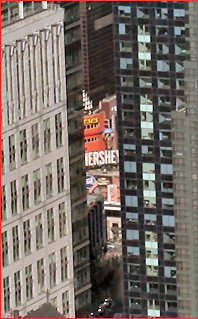 A corner of Times Square from the Empire State Building |
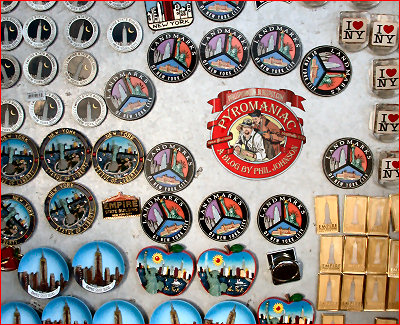 The souvenir rack on the 86th floor |
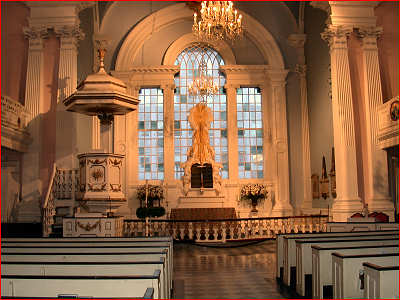 The interior of St. Paul's chapel. This is the Anglican church adjacent to the World Trade Center where rescue workers sought rest and refuge in the days after September 11. It's the oldest continually-occupied building in Manhattan, having been built in 1766. It's also part of the parish that sponsors the infamous "clown eucharists." |
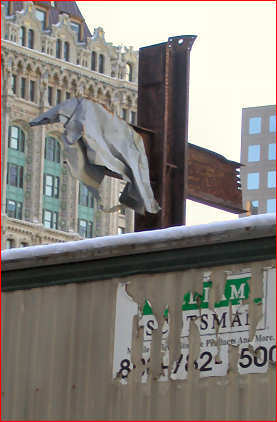 The cross formed by girders that was left standing after the World Trade Center collapse. |
 Frank Turk is right. Christmas season is the ideal time to visit New York. Today couldn't have been better. It was crisp but still and sunny. There's a fresh layer of snow, and much of it (especially in Central Park) is still bright white. Everywhere you go, it seems, traditional Christmas carols are playing. Surprisingly, we didn't hear a lot of cheesy contemporary "holiday" music today. In that regard, at least, New York City seems to be in rebellion against the zeitgeist.
PyroManiac devotes Monday space to highlights from The Spurgeon Archive. The extended quotation (below) is from Charles Haddon Spurgeon and is excerpted from his sermon "Sovereign Grace and Man's Responsibility," originally delivered Sunday morning, August 1, 1858, at the Music Hall, Royal Surrey Gardens, London.

I like how Spurgeon defends the coherence and consistency of truth. He clearly would have abhorred the kind of thinking existentialist philosophers and neo-orthodox theologians have managed to foist on the public consciousness for almost a century now—namely, the absurd notion that all truth is inherently "paradoxical." Make no mistake: many who talk nonstop about the principle of paradox really do seem to imagine that God's revealed truth is full of contradictions, which is tantamount to calling it nonsense.
Spurgeon, by contrast, says we should never imagine that God's truth is at odds with itself. Rather than portraying the twin truths of divine sovereignty and human responsibility as an "antinomy" (a self-contradictory principle) or even a "paradox" (an "apparent" contradiction), he wisely describes these truths as apparently parallel.
Spurgeon is certain the truth of God's absolute sovereignty and the reality of human responsibility are not so truly and eternally distinct from one another that they will never come together. While acknowledging that it's not easy to see how they come together, he avoids any suggestion that they are in any way in conflict with one another. "Nearly parallel," he calls them:
The system of truth is not one straight line, but two. No man will ever get a right view of the gospel until he knows how to look at the two lines at once.
I am taught in one book to believe that what I sow I shall reap: I am taught in another place, that "it is not of him that willeth nor of him that runneth, but of God that showeth mercy."
I see in one place, God presiding over all in providence; and yet I see, and I cannot help seeing, that man acts as he pleases, and that God has left his actions to his own will, in a great measure.
Now, if I were to declare that man was so free to act, that there was no presidence of God over his actions, I should be driven very near to Atheism; and if, on the other hand, I declare that God so overrules all things, as that man is not free enough to be responsible, I am driven at once into Antinomianism or fatalism.
That God predestines, and that man is responsible, are two things that few can see. They are believed to be inconsistent and contradictory; but they are not. It is just the fault of our weak judgment. Two truths cannot be contradictory to each other.
If, then, I find taught in one place that everything is fore-ordained, that is true; and if I find in another place that man is responsible for all his actions, that is true; and it is my folly that leads me to imagine that two truths can ever contradict each other.
These two truths, I do not believe, can ever be welded into one upon any human anvil, but one they shall be in eternity: they are two lines that are so nearly parallel, that the mind that shall pursue them farthest, will never discover that they converge; but they do converge, and they will meet somewhere in eternity, close to the throne of God, whence all truth doth spring.

Personal update
By the way, Darlene and I are in New York City for the next few days. We flew here Sunday evening after church, and we'll return home late Thursday, if the Lord permits.
Darlene was born in upstate New York, and I've been there, seen Niagara Falls, and sensed the spiritual deadness of Finney's infamous "Burnt District." But I've never really visited New York City except for a few hours at a time—always on travel layovers and whatnot.
I first came through here several years ago. That was literally underground, by train, arriving in Penn Station (right under Madison Square Garden) just after midnight for a 1-hour layover. Twice I've sailed into the harbor and seen the Statue of Liberty from the deck of a ship at 5:00 AM. And I've flown through JFK dozens of times, twice stopping to spend the night on my way to and from London. One of those two times, Darlene and I splurged and stayed in a hotel right in Times Square.
But I have never seen New York.
I want to visit Ground Zero, take Darlene to the top of the Empire State Building, and walk in Central Park. There's never been time to do any of those things when we've breezed through here in the past.
So when I learned my friend Christopher Parkening (arguably the finest classical guitar player in the world) and my favorite singer, Jubilant Sykes, are giving a Christmas concert together in Manhattan this week, Darlene and I decided that's how we would spend my remaining vacation-days this year. That's what has brought us here. It's pure vacation, and a rare treat for me.
Before leaving, I finished all the work on my desk (except a thousand unanswered e-mails [sorry]), so it's my first fairly pressure-free, genuine vacation in a long time.
Why am I blogging? I wanted to. If time permits, I'll probably try to write something for the blog each evening this week. But unless the weather is really bad and we end up confined to a hotel room, don't look for anything profound or totally serious until I get back home.
 Marla Swoffer is absolutely right: Mormonism is not authentic Christianity. Mormonism has never been deemed anything other than a cult by mainstream biblical and historic Christianity. For their part (until very recently) Mormons have always denied being mainstream Christians anyway. They claim true Christianity was totally lost and the church was dead until Christ began "the Restoration" under Joseph Smith.
 After Katrina hit Mississippi and Louisiana, I was flooded with e-mails from people looking for suggestions about how to help.
|
 Tuesday was an interesting day. Among other things, I finally got to meet two of the Fide-o guys, Scott and Jason.
 I have in my library a book by the spiritual father of a quasi-Christian cult. He argues that doctrinal statements, systematic theology and propositional truth claims are contrary to the spirit of Jesus' ministry.
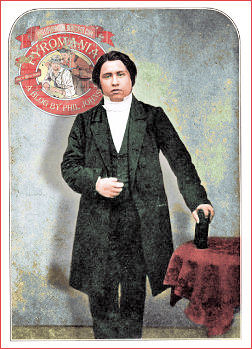 My good friend James Spurgeon (not a direct descendant of the Prince of Preachers, but quite a fine Baptist preacher himself) proofread five new sermons from the 1885 volume of The Metropolitan Tabernacle Pulpit, which have now been added to
  :
:Now, this riding of Christ upon an ass is remarkable, if you remember that no pretender to be a prophet, or a divine messenger, has imitated it.
Ask the Jew whether he expects the Messiah to ride thus through the streets of Jerusalem. He will probably answer "No." If he does not, you may ask him the further question, whether there has appeared in his nation anyone who, professing to be the Messiah, has, at any time, come to the daughter of Jerusalem "riding upon an ass, and upon a colt the foal of an ass."
It is rather singular that no false Messiah has copied this lowly style of the Son of David. When Sapor, the great Persian, jested with a Jew about his Messiah riding upon an ass, he said to him, "I will send him one of my horses": to which the Rabbi replied, "You cannot send him a horse that will be good enough, for that ass is to be of a hundred colors." By that idle tradition the Rabbi showed that he had not caught the idea of the prophet at all, since he could not believe in Messiah's lowliness displayed by his riding upon a common ass. The rabbinical mind must needs make simplicity mysterious, and turn lowliness into another form of pomp.
The very pith of the matter is that our Lord gave himself no grand airs, but was natural, unaffected, and free from all vain-glory. His greatest pomp went no further than riding through Jerusalem upon a colt the foal of an ass.
The Mohammedan turns round with a sneer, and says to the Christian, "Your Master was the rider on an ass; our Mohammed was the rider on a camel; and the camel is by far the superior beast." Just so; and that is where the Mohammedan fails to grasp the prophetic thought: he looks for strength and honor, but Jesus triumphs by weakness and lowliness.
How little real glory is to be found in the grandeur and display which princes of this world affect! There is far more true glory in condescension than in display. Our Lord's riding on an ass and its foal was meant to show us how lowly our Savior is, and what tenderness there is in that lowliness. When he is proclaimed King in his great Father's capital, and rides in triumph through the streets, he sits upon no prancing charger, such as warriors choose for their triumphs, but he sits upon a borrowed ass, whose mother walks by its side. His poverty was seen, for of all the cattle on a thousand hills he owned not one; and yet we see his more than royal wealth, for he did but say, "The Lord hath need of them," and straightway their owner yielded them up.
No forced contributions supply the revenue of this prince; but his people are willing in the day of his power. He is thy King, O Zion! Shout, to think that thou hast such a Lord! Where the scepter is love, and the crown is lowliness, the homage should be peculiarly bright with rejoicing. None shall groan beneath such a sway; but the people shall willingly offer themselves; they shall find their liberty in his service, their rest in obedience to him, their honor in his glory.
 One of my lurking readers, Johnathan Tate, sends me a link to a BBC news article reporting that a German Protestant youth group has produced a calendar featuring nude "Bible characters." I'd post a link to the article, but it includes a PG-13 graphic that exceeds the limits of what I'm willing to link to.
Youths reveal racy Bible calendar
A German Protestant youth group has put together a 2006 calendar illustrated with erotic scenes from the Bible.
The 12 re-enacted passages feature a bare-breasted Delilah cutting Samson's hair and a nude Eve offering an apple.
The Nuremberg-based group said they wanted to represent the Bible in a way that would entice young people.
Nuremberg pastor Bernd Grasser said: "It's just wonderful when teenagers commit themselves with their hair and their skin to the bible."
"There's a whole range of biblical scriptures simply bursting with eroticism," said Stefan Wiest, 32, who took the racy photographs.
Anne Rohmer, 21, wearing garters and stockings, posed on a doorstep as the prostitute Rahab.
"We wanted to represent the Bible in a different way and to interest young people," she told news agency Reuters.
"Anyway, it doesn't say anywhere in the Bible that you are forbidden to show yourself nude."
Bernd Grasser, pastor of the church in Nuremberg where the calendar is being sold, said he was supportive of the project.

"Let your light so shine before men, that they may see your good works, and glorify your Father which is in heaven" (Matthew 5:16).